Category Published Articles

4 Corners: An Interview with Marlon Darbeau

This month we head to the birthplace of steelpan and calypso music, Trinidad and Tobago. This vibrant melting pot of the Caribbean is home to a rich and diverse community of cultures primarily influenced through colonization and immigration.

It is also a culture steeped in the Arts. With many celebrated sons and daughters such as Nobel Prize-winning authors V.S. Naipaul and Derek Walcott; theatrical talents such as Tony Award winners Geoffrey Holder and Heather Headley; and the fantastic, globally-renowned, carnival costume designer Peter Minshall.

And in design terms, it’s no surprise that the practical crafts that are self-evident in the culture that surrounds the art of  ‘The Mas’ tradition of carnival should influence the work of Trinidad & Tobago’s professional designers.

One such creative is multi-disciplinary designer Marlon Darbeau, whose own family background of ‘making things’ informs both his professional and personal work. A man of action, let’s hear it in his own words…

Marlon Darbeau, creative director and designerMarlon Darbeau

Source: Kibwe Brathwaite

What’s your background?

I was born and have lived and worked in Trinidad & Tobago all my life. I attended John Donaldson Technical Institute and I am a graduate of the College of Science Technology and Applied Arts of Trinidad and Tobago. I worked for about five years as a graphic designer at MDC Signs followed by three years freelancing. I then spent six years at CMB Advertising, before becoming creative director of Abovegroup, now AbovegroupOgilvy. I come from a family tradition of making things in a workshop at home. In the last six to seven years I have become very interested in how those traditions intersect with my practice as a graphic designer, and in using this convergence to formulate ways of making my work. This convergence has lead to the creation of self-initiated projects, most notably ‘Peera’ a reinterpretation of a traditional small bench, which has been exhibited at the Museum of Art & Design NY The Global Africa Project.The Peera bench

The Peera bench

How did you get started in design?

I actually started off soon after school, taking a course in fabric design which led to a few years of hand-painting T-shirts; really fun times. When I was around 19 and enrolled part time at John Donaldson Technical Institute, a friend stopped by my home where I had a small studio space in my father’s metal workshop. He happened to mention that the sign company where he had been working as a salesman needed a graphic designer. With no computer experience and my portfolio filled with drawings and paintings I interviewed for the job and got it. My training at school at the time did not involve any software tools so I enrolled in a short course to get my Adobe Illustrator skills so it was really on the job training. This is before plotters were introduced locally, so you outputted your artwork via a desktop printer then projected the image on to large paper on the studio wall, and then you would produce actual-size drawings for the production team. The great thing about being a designer in a signage workshop is that you are very much part of the manufacturing process. This has been a major influence on my practice as it taught me about the process of making ideas tangible.Alice Yard identity

Alice Yard identity

What challenges did you face in getting into the industry and achieving your ambitions?

I will say the most difficult thing in Trinidad & Tobago as a graphic designer is developing your own visual language. Unlike other places where you can see clear articulations of design styles, we have a sort of sameness. Operating in an industry with no professional design association can be hard. Where there is no collective agenda to improve design as a professional craft, designers, clients and the public don’t fully benefit, it’s a sort of hit and miss. I was not interested in doing things the way others were doing it, I believe design is a professional craft and I really wanted to develop a way of thinking and expressing ideas through client and personal work. That is very challenging when you are operating in an industry where the role of design has not been formally considered; it takes a lot to avoid being sucked into advertising despondency and economic necessity.

Who are your greatest inspirations and influences?

I feel very fortunate to have met some really great people over the last 18 years, all of whom have been so influential. From Val Ramcharan, my design lecturer at John Donaldson who pushed me to explore and develop my design sensibilities. Graphic designer Richard Rawlins who basically said to me one day ‘ start making all those ideas you have in your sketch book don’t keep them locked away’ which lead to my first one man show ’EnRoute…of bridges and barriers’ an expression of design being used for more than just selling things, it was attempt to address social concerns. Back in 2008 while working with the likes of Richard Rawlins, Dave Williams, Daryn Boodan, Rodell Warner and Damian Libert, we became an informal but very active collective, each person having their individual creative ambitions yet were able to come together to develop our own practices while affecting our visual landscape, that was a significant moment in my life. The architect Sean Leonard, who has been a mentor and friend. The work of Stefan Sagmeister, Steve Ouditt and Christopher Cozier.Work for 12 The Band

Work for 12 The Band

What is the project you are most proud of?

‘Verb’, a multifunctional object I created and showed in New Orleans in 2009, is very close to my heart as I created that project while trying to design a symbol for myself. The object is a physical manifestation of the graphic I created, symbolising a dance between intent and intuition. Another project is Peera as it really solidified my way of working through process, resulting in my conviction to design BY MAKING.Verb multifunctional sculpture/furniture

Verb multifunctional sculpture/furniture

What would be your dream job or project?

I will love to design the identity for a football team as well as design and produce a project directly inspired by the mailboxes my dad manufactures.

Please name some people in your field that you believe deserve credit or recognition.

I think Gareth Jenkins and Alex Smailes deserve a lot of credit for what their company Abovegroup (studio with a focus on design and branding) did here at home. Most designers go to work for advertising agencies, which is fine, but there are so many who would love the opportunity to practice design in a particular way which the agency model does not facilitate, and these guys created a model that gave designers the opportunity to focus on design outside of campaigns. Their process opened a conversation about the improvement of design as a professional practice and lead to the transformation of some of Trinidad & Tobago’s small, medium and large organizations.

What’s your best piece of advice for those wanting to follow in your footsteps?

’’Design is work.’ Don’t be afraid to explore it’s possibilities, care about what you do, work at your craft and be honest.

What’s next for you?

I am working on two new projects, a commission and a self-initiated project, really exciting.

You can see more of Marlon Darbeau’s work at www.marlondarbeau.com.Dishout salad servers

Dishout salad servers

Network

THE U.S:

Harlem Postcards commissions artists to photograph Harlem, and turns their unique depictions of the neighborhood into free, limited-edition postcards. Launched in 2002, this project was created to provide alternative, multifaceted views of Harlem, representing its complex and diverse history, and capturing the community in a critical moment of growth and change. Exhibition runs until 27 October 2013 at Studio Museum of Harlem, 144 West 125th Street, New York, New York. See more at:http://www.studiomuseum.org/exhibition/harlem-postcards-tenth-anniversary

Future Beauty: 30 Years of Japanese Fashion on view at the Seattle Art Museum (SAM) from June 27 through September 8, 2013, will feature more than 100 costumes by celebrated and original designers including Issey Miyake, Rei Kawakubo, and Yohji Yamamoto as well as younger designers influenced by popular culture and the dynamic street life of Tokyo. For more information, go to www.seattleartmuseum.org

THE CARIBBEAN:

Trinidad & Tobago Film Festival 2013 Founded in 2006, the trinidad+tobago film festival (ttff) is an annual celebration of films from and about Trinidad & Tobago, the Caribbean and its diaspora. The Festival also screens films curated from contemporary world cinema. In addition, the ttff seeks to facilitate the growth of the Caribbean film industry by hosting workshops, panel discussions, seminars, conferences and networking opportunities. Date: 17 September – 1 October 2013. For more information visithttp://www.ttfilmfestival.com

Carifesta XI A Caribbean festival of arts and culture showcasing the excellence of the region’s peoples. This year has the distinction of premiering a new logo for the festival. Runs from 16 – 25 August in Suriname. For more information visit Carifesta XI website

EUROPE:

Origins of the Afro Comb:
6,000 years of culture, politics and identity
The 6,000-year history of the Afro Comb, its extraordinary impact on cultures worldwide, and community stories relating to hair today are being explored in this new exhibition Fitzwilliam Museum: Gallery 13 (Mellon) & 8 (Octagon) Trumpington Street,
Cambridge CB2 1RB. Free Entry. Exhibition runs from 2 July – 3 November 2013. 
For more information visit http://www.fitzmuseum.cam.ac.uk/whatson/exhibitions/article.html?3840

AFRICA:

Cape Town Fashion Week. From 8 – 10 August 2013.Hosted at Cape Town International Convention Centre. Convention Square 1 Lower Long Street Cape Town. South Africa. For more information on South Africa’s premiere film event visit African Fashion international website

4 Corners: An Interview with Lulu Kitololo

This month we focus on my hometown, London. As the first generation offspring of African-Caribbean parents born in the mid Sixties, I did not always find it easy to embrace my ‘Britishness’.

However, I’ve certainly never had any problems identifying myself as a “Londoner” – for London truly is the world within a single city.

Home to every conceivable nationality, this cosmopolitan metropolis pulses with its vibrant mix of cultures. And it is from this dynamism that the opportunity for new voices can emerge. New voices like those of Lulu Kitololo and her design company Asilia, whose work is not just resonating on these shores, but also beyond.

I have watched their work progress over the past few years with eagerness; appreciating its distinctly African roots whilst bringing a fresh modern approach and aesthetic.

It’s a design voice I really like, so let’s hear all about it from Lulu in her own words.Lulu Kitololo

Source: Jonathan Perugia

Lulu Kitololo

What’s your background?

I was born and raised in Nairobi, Kenya. I was always creating things as a child – constructing shelters indoors when the weather was miserable; making trains for my dolls out of fruit cartons; experimenting with food in the kitchen; ‘refashioning’ my dresses (much to my mother’s dismay) and; of course, making images on paper. My parents were generally very encouraging of these pursuits but, being that I excelled at all subjects in school, I don’t think they – and many others – were fully prepared for the decision I made to pursue a creative profession.

I went to art school, Pratt Institute in New York, not quite sure what to specialise in and I ended up pursuing a Communications Design degree with a major in Advertising Art Direction. Thereafter, I worked for a couple of advertising agencies but something about it just wasn’t for me.

I ended up going back to school, this time to pursue a Masters in African Studies at SOAS, University of London. It was a fantastic year – learning about African politics, culture, film and literature. There were several interesting responses I experienced from people at that time including, “but you’re African, why do you need to study Africa?” and, “what are you going to do afterward?”

At the time, I had no idea what I was going to do afterward but I was very content with what I was doing and had faith that a path would reveal itself. I stumbled across a design job with a sustainability communications agency, Futerra, and it seemed a perfect opportunity to combine my creative expertise with my interest in development. I worked there for over 3 years and then left because I yearned for the freedom of self-employment. I’ve since gone into business with a friend and our creative agency, Asilia will be celebrating 3 years later this summer. It’s been an amazing journey, creating a niche for ourselves on the back of our distinctive style; our presence in both London and Nairobi and; our journey into creating products as well providing creative services. I’m very excited about what the future holds for us.Film Africa print materials

Film Africa print materials

How did you get started in design?

The skills and knowledge I gained as part of my Bachelor of Fine Arts degree have been invaluable. However, the most significant thing I learned during those 4 years was not explicitly taught and that was – how to be resourceful.

I think resourcefulness and experience are great tools for any designer. Experience is something that comes with, well, experience. From my 2nd year of university, I was taking every opportunity to gain work experience in my field. This involved seeking out internships and volunteering my design services to people I came across who were doing things I was interested in.Identity for Afri-Love - African inspired creative production

Identity for Afri-Love – African inspired creative production

What challenges did you face/overcome in getting into the industry and achieving your ambitions?

It’s really important for me to do work whose subject I’m passionate about and, starting out, I didn’t always have this opportunity. In fact, there was a point where I was about to give up on design altogether, primarily for this reason. Making the decision to be self-employed was scary, for obvious reasons, however, the prospect of having more control over the projects I would work on, was very exciting… and has been very satisfying. It’s one of the best decisions I’ve made.

In my personal experience, my background has never really felt like a barrier to getting into the industry and achieving my ambitions. However, as a company operating in the UK, I sometimes wonder if people’s perceptions of Asilia preclude us from winning certain projects. A lot of our work has had an African focus and my business partner and I are of Kenyan origin so, I think that some people assume that we only work on Africa-related projects. So this is the current challenge that I’m/we’re facing and the approach at the moment is to continue to focus on doing great work. I believe that we will continue to attract the kind of people that we enjoy working with.Afri-love - illustration for post on why Ghana will be the next African app powerhouse

Afri-love – illustration for post on why Ghana will be the next African app powerhouse

Who and/or What are your greatest inspirations and influences?

I’m greatly inspired by craft traditions from around the world. I always find joy in the diversity of textiles, patterns, adornments and vibrant colour combinations and I aim to capture that same excitement in my work.

Discovering Chaz Maviyane-Davies was very inspiring and in particular, his insistence that design should express the context within which it’s created, in terms of speaking to its culture and not just emulating a Western ideal.

Marian Bantjes is another big inspiration. I love the playfulness, intricacy and amazing level of craftmanship in her work, as well as her sass and confidence!Spora Stories identity

Spora Stories identity

What is the project you are most proud of?

This is such a difficult question and the answer constantly evolves. One of the projects I’m most proud of is the work we did for the Film Africa festival. It was great to have such a visual project, in terms of our work being seen all over town and, the response we’re still receiving now, from different people, is really positive.

I’m also really proud of the work we did for the African Union Campaign for Accelerated Reduction of Maternal, Newborn and Child Mortality in Africa (CARMMA). Particularly, the iconography we developed and the infographics we designed which, help to make a serious subject much more accessible to a wider audience.

What would be your dream job or project?

I think I’m living my dream job right now. Dream project? I would love to work with museums and cultural institutions like the Southbank Centre.Web design for Campaign on Accelerated Reduction of Maternal Mortality in Africa

Web design for Campaign on Accelerated Reduction of Maternal Mortality in Africa

Please name some people in your field that you believe deserve credit or recognition, and why.

I’ve lately come across quite a few small, independent agencies in Africa that are doing some exciting work. In Kenya (and I believe this may be true for other countries on the continent), international advertising agencies (e.g. TBWA, Ogilvy etc.) have a kind of monopoly when it comes to the communications/design industry. It’s refreshing to see these smaller, and often much more creative, shops emerging and doing well.Legal Defence Initiative prints

Legal Defence Initiative prints

What’s your best piece of advice for those wanting to follow in your footsteps?

Get as much experience as you can, start as early as you can and be creative about how you find it. There is a lot of competition in our field so don’t expect a long list of design internships and work placements for you to choose from. Think outside the box. I got one of my first opportunities by attending a networking event that had nothing to do with design, meeting a publisher and volunteering my services for his up and coming magazine.

Another important thing – never underestimate the value of experimentation and play. Some of the best ideas come from that.

What’s next for you?

Asilia is working on developing some design and digital products. Look out for our online shop and a couple of app launches in the next few months.

Network:
THE U.S:
AFRICOBRA: Art & Impact honours the Chicago artist group, AfriCOBRA (African Commune of Bad Relevant Artists). Exhibition is presented by 3 South Side institutions and runs from 26 July until 29 September 2013. For more information, go to http://www.dusablemuseum.org/events/details/africobra-the-dusable-museum-programming
THE CARIBBEAN:
Belize International Film Festival. This is the eighth edition of the festival focusing on films from the Caribbean and Central America. Date: July 11-15, 2013. For more information visit www.belizefilmfestival.com
EUROPE:
Design On Stage exhibition presents the best product innovations of the year. Red Dot Design Museum, Gelsenkirchener Straße 181
45309 Essen, Germany. Exhibition runs from 2 – 28 July 2013. For more information visit http://en.red-dot.org/5005.html
AFRICA:
Durban International Film Festival 2013. Hosted by the University of KwaZulu Natal’s Centre for Creative Arts, the Durban International Film Festival will be celebrating its 34th edition from 18 to 28 July 2013. For more information on South Africa’s premiere film event visit www.durbanfilmfest.co.za  

4 Corners: An Interview with Gail Anderson

I love NY. The first time I visited the city was in the early 1980s when I was aged around 16 years old. My father’s side of the family occasionally held large family reunions either in the US or the Caribbean and so we went over to New York on our way to attend a reunion in New Jersey.

We stayed with family in Brooklyn, and I was fascinated with everything about it and the fact that it all felt so familiar. Here I was walking around the real life film set of my dreams with the soundtracks of TV shows like Starsky & Hutch and films like Car Wash reverberating around my mind.

From a design perspective, I couldn’t help but be consumed by the mega-brand bombardment that screams out at you on all corners. From the bright neon signs and huge billboard advertisements to the plethora of product packaging, confectionery and magazine covers that adorn the news-stands. It is with reference to the latter, and magazine design in particular, that I bring to your attention now.

Rolling Stone magazine was, and continues to be one of the most highly regarded and influential publications of its time. Working during the years stewarded by the prolific and distinctive art director, Fred Woodward, was an African American woman who has blazed her own trail as a designer, art director, author and educator. Her work is honored and celebrated in publications and awards annuals all over the world. And if it hasn’t been done already, her name should be lit up in neon on the side of a skyscraper like the signs that adorn her hometown, New York.

It is my pleasure to introduce you to Gail Anderson.Gail Anderson

Source: Darren Cox

Gail Anderson, designer, writer and educator.

What’s your background?

I’m born and raised in New York, originally from the Bronx. My memories of the neighborhood I grew up in defy the stereotype of a crime-ridden slum. There were trees and houses with driveways, and kids on bikes. My parents are from Jamaica, so I am first-generation American, and first-generation college-educated, as well. I attended college at the School of Visual Arts in Manhattan, and worked first at Random House, followed by the Boston Globe Sunday Magazine, where I had my first exposure to editorial design. From there, I moved back to New York to work with Fred Woodward at Rolling Stone, where I remained for over 14 years. I served as creative director of design at SpotCo, a NYC-based entertainment advertising agency that focuses on Broadway for a little over eight years, and am now a partner in a boutique design firm that doesn’t even have a website yet (I still have my own site, gailycurl.com though it is hopelessly outdated). I teach at the School of Visual Arts in the undergraduate and graduate design programs (I’ve been teaching for most of my career).'The Next Queen of Soul' Rolling Stone spread

‘The Next Queen of Soul’ Rolling Stone spread

How did you get started in design?

I was fortunate to have a smart and plugged-in studio art teacher in high school, who sent me off to take weekend drawing classes at Pratt Manhattan, and made sure that I participated in competitions and exhibitions. She loaned me books about what was then called ‘commercial art’, and pushed me to attend the School of Visual Arts.

What challenges did you overcome in getting into the industry and achieving your ambitions?

I was not a cool kid from the city, living in the East Village like most of my young colleagues right out of school. I was a dopey kid living with her parents in the Bronx. My hipness factor was extremely low. I didn’t encounter any real issues as a minority, though I was always the one people called on for ‘another’ point of view. That caused a good deal of eye-rolling when I was younger, but is something I’ve grown accustomed to in my dotage.'Chris Rock - Star' Rolling Stone spread

‘Chris Rock – Star’ Rolling Stone spread

Who are your greatest inspirations and influences?

My friend and boss at the Boston Globe, Lynn Staley, was a huge influence. I feel like I matured as a young designer under her tutelage and was able to start my next job at Rolling Stone with my sleeves rolled up, ready to get my hands dirty thanks to her. Fred Woodward, probably the smartest man in magazines, and a dear and gentle soul, is my other strong influence, along with the work of Paula Scher.'Axl Rose Lost Years' Rolling Stone spread

‘Axl Rose Lost Years’ Rolling Stone spread

What is the project you are most proud of?

I’m proud of a series of subway posters I worked on with illustrator Terry Allen for the School of Visual Arts after President Obama’s first-term election. And I’m still fond of much of the old Rolling Stone work – it still holds up almost two decades later.Obama Lion poster (with Terry Allen)

Obama Lion poster (with Terry Allen)

What would be your dream job or project?

I got to work on my dream project about a year ago; designing a postage stamp for the US Postal Service. And now I serve on the Citizens’ Stamp Advisory Committee, as one of the team of folks who helps decide what future stamps are on the horizon. I am honored to be part of the Design Subcommittee, and am looking forward to the challenge. My partner Joe Newton and I are currently working on rebranding a small art college in Pennsylvania. I’d like to do more of this kind of work, so I’ll put that in the dream category – more academic institutions.Emancipation stamps

Emancipation stamps

Please name some people in your field that you believe deserve credit or recognition, and why.

Boy, do teachers ever deserve more recognition and credit than they get! And more money, too!

What’s your best piece of advice for those wanting to follow in your footsteps?

Be the first one in the office in the morning, and the last one to leave at night. Never send an angry email, and read Malcolm Gladwell’s Outliers.Cover for New Modernist Type, by Steven Heller and Gail Anderson

Cover for New Modernist Type, by Steven Heller and Gail Anderson

What’s next for you?

I am heading to Italy with my sister and niece this summer. That’s about all I can think about these days.

Network:

THE U.S:

Gordon Parks – A Harlem Family: An exhibition honouring the legacy and work of pioneering African-American artist, photojournalist and true renaissance man, Gordon Parks. Exhibition runs until Jun 30 at The Studio Museum of Harlem. 144 West 125th Street, New York, NY 10027 For more information, go to www.studiomuseum.org

THE CARIBBEAN:

The Alliance Française of St. Vincent presents a Caribbean Photography Exhibition. Featuring the work of photographers from St. Vincent & The Grenadines, St. Lucia, St. Kitts & Nevis and Jamaica. The exhibition will be open until May 31st, 9:30am to 5.00pm weekly and 2.00pm on Fridays at the Alliance Française, Carnegie Building (1st Floor), Heritage Square, Kingstown, St. Vincent. For more information email: afofsvg@gmail.com, visit www.facebook.com/afsvg or by call: 456-2095.

AFRICA:

Africa Day Celebrations. Artscape celebrates Africa Day with a concert featuring Bongani Sotshononda’s indigenous ensemble, The Cape Philharmonic Youth Orchestra, The SA Youth Choir and Khayelitsha Mambazo. 25 May at 7.30pm at the Artscape Theatre, Cape Town City Centre, Cape Town 8000, South Africa Tel: +27 21 410 9800. For more information visit http://www.artscape.co.za/show/africa-day-celebrations/665/

EUROPE:

Design En Afrique is an exhibition focused primarily on the design of objects used as support for the body. Runs until July 2013 at Museum Dapper in Paris, France. 35 bis, rue Paul Valéry – 75116 Paris. For more information visit http://www.dapper.fr

4 Corners: An Interview with Saki Mafundikwa

This month we take a trip to ‘The Motherland’, Africa. A continent, that certainly earns its status as the cradle of civilization due to the fact that most scientific research points to this as being the place of where Man first originated.
Historically, evidence of African art and design can be found within almost all cultures and societies across the world. From the tribal, geometric and abstract forms that inspired the paintings of Picasso and the roots of Modernism to the ancient Adinkra symbolism that is reflected in many European decorative design elements and fabrics.
For those of you unfamiliar with Adinkra symbols, they are a comprehensive lexicon of visual icons created by the Akan people of Ghana and Gyaman people of Cote d’Ivoire in West Africa and devised to communicate proverbs.
They are just one of the many African writing systems that were highlighted by the distinguished Zimbabwean graphic designer, Saki Mafundikwa in his landmark and definitive book on the subject, Afrikan Alphabets.
And as this month celebrates the anniversary of Zimbabwe’s Independence, I can think of no more fitting designer to introduce to you today.Saki Mafundikwa

Source: Aahn Sang Soo

Saki Mafundikwa, founder and director of the Zimbabwe Institute of Vigital Arts (ZIVA).

What’s your background?

I’m Founder and director of the Zimbabwe Institute of Vigital Arts (ZIVA), a graphic design and new media training college in Harare. I was educated in the USA, with a BA in Telecommunications and Fine Arts from Indiana University and an MFA in Graphic Design from Yale University. I returned home in 1998 to found ZIVA after working in New York City as a graphic designer, art director and design instructor. My book, Afrikan Alphabets: the Story of Writing in Africa was published in 2004. My first film, Shungu: The Resilience of a People – a feature-length documentary – had its world premiere at 2009’s International Documentary Film Festival Amsterdam (IDFA). It won the prestigious Ousmane Sembene Award at Zanzibar International Film Festival and Best Documentary at Kenya International Film Festival, both in 2010.

How did you get started in design?

I was a talented child and was always drawing, which led my father (a school teacher) to buy me a drawing book, crayons and water colours. I grew up in colonial Rhodesia and for Afrikan kids, art was not offered as a subject in the curriculum. So I taught myself drawing through observation. I looked everywhere: nature and everyday life. I drew my father’s charts for his history, geography and science lessons and discovered that I enjoyed lettering the most. It was only after my arrival in the States in 1980 that I discovered graphic design! I talked my way into the department without a portfolio. I never looked back.Identity for the Black Documentary Collective

Identity for the Black Documentary Collective

What challenges did you face in getting into the industry and achieving your ambitions?

After grad school, I moved to New York and worked for a black-owned ad agency. They had hired me my last summer of grad school so I never went through the process of hunting for a job. I learned a lot on that job but after a while, the work wasn’t challenging enough so when they laid me off during a slump in business, I struck out on my own, freelancing for a variety of clients. I did a lot of book design, album and cd design and anything else that came my way. The main challenge I faced in those days – at least I thought it was a challenge – was I was always typecast! I always got ‘black’ projects from mainstream clients. Soon however I realised that it wasn’t such a bad thing because of the sensitivity I gave the work. I came to the conclusion that, in a predominantly white industry, to be called upon to create work for your own people is a source of great pride. Design is not very well understood in the black community, so to be able to create work the people could relate to was quite inspiring. This way, I felt, I could help our people understand and appreciate good design. One can draw from our rich cultural heritage in a subtle way and when the audience ‘gets it’, well, there’s no better feeling!Cover design for Thomas Mapfumo's Corruption album

Cover design for Thomas Mapfumo’s Corruption album

Who are your greatest inspirations and influences?

My source of inspiration can come from anything or anywhere. Everything around me comes into play by keeping an open mind. My work has been influenced by a I draw my inspirations and influences from the great Afrikans from all forms of creativity. Bob Marley, Fela Anakulapo Kuti, Jimi Hendrix, Otis Redding, Kwame Nkurumah, Marcus Garvey, Malcom X, Cheikh Anta Diop, Franz Fanon, Patrice Lumumba, Thomas Sankara… there are many!

The ancient Afrikans of antiquity who created civilization, mathematics, science and invented the alphabet in Egypt… yes, we have a glorious past and we can – no, make that SHOULD – learn from them. They are a source of great pride and inspiration and their accomplishments and contributions must be part of every curriculum in every school from grade one.

What is the project you are most proud of?

My Afrikan Alphabets book! As you can see from the previous question, I am a researcher and historian, especially OUR story! There should be more books, especially for the young ones, and our students. We keep talking about design being Eurocentric but without resources like textbooks about and by us, how do we expect the young ones to ‘get it’? We got it through years of study and research. We must provide them with the resources.Afrikan Alphabets

Afrikan Alphabets

What would be your dream job or project?

A design textbook for Afrikan students on the continent and in the diaspora. This would be a dream come true. I have already begun work on this project.

Please name some people in your field that you believe deserve credit.

All the Afrikans who invented writing systems whether living or dead. These people rendered the commonly held belief that Afrika had no writing, (the dark continent myth) moot. The two professors at Indiana University who took a chance on me and admitted me into the graphic design department without a portfolio: Professor Tom Coleman and Professor James Reidhaar. The head of department at Yale University School of Art, Alvin Eisenman is the one who pointed me in the direction of writing in Afrika when I was applying for admission to the Masters programme there. I had some amazing teachers along the way, and the best one is Bradbury Thompson who is the most humane and caring teacher I’ve ever had.

What’s your best piece of advice for those wanting to follow in your footsteps?

Always keep an open mind, if you don’t you block some blessings that might be meant for you. As the original people, children of the sun, we have such a rich bounty of inspiration: our music, dance and art – they are all connected, there is no separation. Sankofa: learn from our rich past in order to inform our lives today and the future.Identity for the Zimbabwe Institute of Vigital Arts

Identity for the Zimbabwe Institute of  Vigital Arts

What’s next for you?

I have made the transition to film-making seamlessly and am working on my second documentary, which should be out by year’s end. I have a piece of land outside of Harare where I do organic farming, rear cattle and goats and would like to put up some greenhouses for horticulture. I see a strong connecting line between all the things I do. The design school I run in Harare, the books I write, the films I make and the organic farming – they are all connected. Each one informs the other.


Network:

THE U.S:

Lois Mailou Jones – A Life in Vibrant Color: Born in Boston in 1905 and trained at the School of the Museum of Fine Arts, Boston, Loïs Mailou Jones began her career at a time when racial prejudices and gender discrimination were strong in American culture. This exhibition surveys the vast sweep of Jones’s seventy-five years as a painter stretching from late Post-Impressionism to a contemporary mixture of African, Caribbean, American and African-American iconography, design and thematic elements. Exhibition Hall at Schomburg Center for Research in Black Culture. From 19 April through to 29 June 2013. For further information, go to http://www.nypl.org/events/exhibitions/loïs-mailou-jones-life-vibrant-color

THE CARIBBEAN:

International Reggae & World Music Awards (IRAWMA), established in 1982 acknowledges and honors the accomplishments and contributions of reggae and world music artists, including: songwriters, performers, promoters and musicians.

For more information call: 954-251-1643 Or visit: www.irawma.com

AFRICA:
Marketing Indaba The fourth annual Marketing Indaba Conference, will take place on 15 and 16 May in Cape Town. And in Johannesburg on 29 and 30 May. For more information visit http://www.marketingindaba.com

EUROPE:

POINT is a two-day International design conference in London, which aims to celebrate “excellence in design and its influence in contemporary culture and society”. Featuring over 40 top speakers, the conference’s start-up theme is ‘authenticity’. 2-3 May at RIBA. 66 Portland Place, London W1B 1AD. For more information and speaker line-up visitwww.pointconference.com

Alan Fletcher’s Colophon Presented by the Wynkyn de Worde Society and St Bride Foundation. This talk is based around Fletcher’s largely unknown series of books Monographica, and hopes to give some context to their creation whilst at the same time offering an overview of Fletcher’s fifty-year career. Thursday 9 May 2013 at 7.00pm In the Bridewell Hall, St Bride Foundation. Tickets: £15.00. Friends of St Bride Library: £12.50. Students: £10.00 (bring NUS card). For tickets visithttp://www.eventbrite.com/event/5560798498

4 Corners: An interview with Michael Thompson AKA Freestylee

This month we head to the Caribbean, or more specifically one of its biggest islands, Jamaica. Last year was a momentous year in Jamaica’s history; celebrating 50 years of independence from Britain with global events, coupled with the most outstanding display of sprint athletics the world has ever seen at London’s 2012 Olympics.

In sport and music, there is no doubting the enormous impact Jamaica has made on the world, but what about in design?

Were he still alive today, I would have loved to have interviewed Wilfred Limonious; a designer and graphic artist who made a real name for himself in the 80s and early 90s with colourful, charming and characterful artwork for many Jamaican LP record covers – a sample of his work is shown at the end of this article.

Instead, we are extremely fortunate to feature the talents of Michael Thompson, AKA Freestylee. Someone who I believe carries on in Wilfred’s tradition in championing reggae music, but with a strong, sophisticated illustrative style all of his own.Michael Thompson

Michael Thompson, AKA Freestylee. Jamaican graphic designer and founder of the International Reggae Poster Contest.

What’s your background?

I am Jamaican by birth. I left for the United States in 1990, and worked as a freelance graphic designer with companies such as Citigroup, Sanofi Aventis, Bank of America and Estée Lauder. I am also a Creative Activist, using social design as a tool for awareness on a number of international concerns and solidarity. I am the founder of the International Reggae Poster Contest; a visual arts celebration of the positive impact of reggae music globally, and a platform to present a vision to establish a Reggae Hall of Fame in Kingston, Jamaica. I have had a number of international exhibitions of my Freestylee work; one-man show and group exhibitions.Dancehallstylee, by Michael Thompson

Dancehallstylee, by Michael Thompson

How did you get started in design?

I studied graphic design at the Jamaica School of Art. After finishing my studies my first work was in a small screen-printing operation operated by a Rastafarian by the name of Jah Ned. There I learned to experiment with simple silhouetted graphic design concepts suitable for screen-printing and poster art. It was after winning a poster contest to Cuba that I had a break and was hired as an apprentice with the Daily News newspaper in Jamaica. This was a big step closer to what I wanted to do: layout and design. In the mid ‘80s, I was offered a job at Paisley Kelly Kenyon & Eckhart Advertising in Kingston, Jamaica. Many years later, I joined a public relations firm Mike Jarrett Communications, also in Kingston, as an Art Director. My activist poster designs started in the late 1970s. My first activist poster was created after an incident in Jamaica called the “Green Bay Massacre”. This took place 5 January, 1978, where a number of alleged young gang members from a poor inner-city ghetto in Kingston were lured to a military firing range outside the capital where they were ambushed and executed by the Jamaica Defense Force soldiers. Back then, I had no computer so it was strictly hand-painted acrylic on poster paper. My recent episodes of creative activism started about 2008. I began the journey of Freestylee, Artist Without Borders, a new phase in my awareness activism.Emperor Haile Selassie, by Michael Thompson

Emperor Haile Selassie, by Michael Thompson

What challenges did you face/overcome in getting into the industry and achieving your ambitions?

As a young designer just completing art school and without job experience, it was not easy to find positions in Jamaica as a graphic designer or as an illustrator. I had to make connections and work my way through the hurdles by constantly improving my portfolio and finding other opportunities, and use this process to learn new things that later on I could apply to my creativity process. In 1978, I entered a local poster competition and won a place on the Jamaican delegation to the 11th World Festival of Youth and Students in Havana, Cuba. You can imagine the jubilation at the time. This was a massive event with youths from many countries participating in political and cultural activates. I entered again in 1982, and won another place, this time to Moscow, the 12th Festival of youth and students. These competitions and trips further sparked my interest in poster art. The colourful silkscreen and lithograph posters I saw in Cuba, created by ICAIC (Cuban Institute of Cinematic Art and Industry) and its sister offshoot OSPAAAL (Organization in Solidarity with the People of Africa, Asia, and Latin America) made a tremendous impact on my work. If you are familiar with Cuban poster design you can see the influence in my Freestylee posters. It was an exciting and important time for me. The poster competitions and visits to Havana and Moscow created opportunities and opened doors for me in Jamaica, due to the exposure and publicity my works received. Moving to America I had to make new connections and start the process all over again. I had no computer skills to be a designer so I ended up designing T-shirts the old fashioned way for a small company called Wet Paint, in NYC. I later bought a computer and taught myself how to use this new technology. Dancehall, by Michael Thompson

Dancehall, by Michael Thompson

Who are your greatest inspirations and influences?

My source of inspiration can come from anything or anywhere. Everything around me comes into play by keeping an open mind. My work has been influenced by a number of artists, designers and events. The influences do not materialize from any one source. My visit to Havana exposed me to the works of designers in that country and the fine art of poster design. This was an amazing cultural experience that had influenced greatly my design aesthetics. Some of the Cuban designers who greatly influenced my own art are names like René Azcuy, Fabian Muñoz, Nelson Ponce and Eladio Ravidulia. Other contemporary socially conscious artist on my list are JR, Ai Weiwei, Banksy, these are the people I admire for the activism as well as their artworks as well. I also admire the creativity of Greek illustrator and designer, Charis Tsevis, Japanese artist Takashi Murakami, love his fun colorful works. I am also influenced by Roots Reggae Artistes such as, Bob Marley, Peter Tosh and Burning Spear. Their messages of truth, equal rights and Justice are ever inspiring and comforting.

What is the project you are most proud of?

I have no one piece to single out. Yes, some are more memorable of course, because of the impact the work has had. My Haiti Posters, designed in solidarity with the people of Haiti, devastated by the 2010 earthquake, are the ones I am happy to have contributed to the Haiti Poster Project. I am also proud of my Arab Spring posters supporting the grass roots uprising across the Middle East region to remove oppressive governments from their backs.Haiti poster, by Michael Thompson

Haiti poster, by Michael Thompson

What would be your dream job or project?

I have already started on a dream project. The Reggae Hall of Fame. In 2012, I started a “why not?” campaign to establish a Reggae Hall of Fame Museum in Kingston, Jamaica. Interest in this led to my founding the International Reggae Poster Contest. Today, my partner Maria Papaefstathiou, and I have successfully launched the second annual contest in 2013. For the inaugural contest in 2012, we received 1,142 Posters from 80 countries. We also held two exhibitions of the top 100 posters. The first exhibition was held at the National Gallery of Jamaica, and the second at AKTO Design College in Athens, Greece. We also auctioned a selection of posters from the contest in Kingston, Jamaica, and raised over US$6,000 for an important Institution in the history of reggae music, the Alpha Boys’ School. Alpha Boys’ School is a Sister of Mercy run school for wayward boys in Kingston, Jamaica. This school is credited with shaping the musical journey of many of the founding fathers of Reggae Music. Raising money for this school is one of the contest objectives. I also had the opportunity to rebrand the school’s corporate image. The director of the school Sister Susan Frasier, decided to use one of my iconic Poster images to celebrate the school’s new logo.

Please name some people in your field that you believe deserve credit or recognition.

There are many in the field who deserve to be recognized in the field of graphics and poster design. For example, some of the new young Cuban artists who have taken the baton from the earlier masters. Today, access to the wider world is still limited to Cuban designers due to the limited access to high speed Internet and the embargo. Slanted magazine, from Germany, an independent publication on graphic design, typography, photography, and illustration— has launched a crowd-funding initiative for a project to expose the works of the amazing young Cuban poster designers through their magazine. I am delighted that they are reaching out to the young Cuban designers and giving them an opportunity to share their art on such an international scale. There are also other young artist and designers who are creating powerful designs and illustrations; Taj Francis, a young Jamaica illustrator is one to be applauded for powerful and dynamic illustrations. Dane Thompson, who is my son, for his urban design aesthetics that are outside the box. I find his creative visual expression captivating and fresh.

What’s your best piece of advice for those wanting to follow in your footsteps?

I am not always one to give advice, However, the best advice I can give is to be passionate in what you do. Open your hearts and eyes to the issues of the wider world. Educate yourself about the problems confronting a large segment of the world’s population; poverty, oppression and lack of resources we take for granted in the western world. We are designers and we have powerful tools at our disposal so lets use them to help bring about positive change and support those who are making a difference for the marginalized and impoverished people of the world.Egypt Revolution, by Michael Thompson

Egypt Revolution, by Michael Thompson

What’s next for you?

I am looking forward to new opportunities for Freestylee exhibitions in 2013. At the moment, I am in discussion with a gallery in New York, for an upcoming Freestylee poster exhibition in Spring. On 14 April 2013, I will be conducting a talk about my work at the Allentown Arts Museum in Allentown, Pennsylvania. I am also looking ahead for more creative activism initiatives that will make a difference, and to expand the International Reggae Poster contest campaign toward our objective the Reggae Hall of Fame Museum.

Nah Leave Di Area, by Wilfred Limonious

Nah Leave Di Area, by Wilfred Limonious

Wild Apache album cover, by Wilfred Limonious

Wild Apache album cover, by Wilfred Limonious

Christmas Time, by Wilfred Limonious

Christmas Time, by Wilfred Limonious

Special thanks and credits to Maria Papaefstathiou, graphic designer and blogger based in Greece and to the record label, Power House and Christopher Bateman for use of the Wilfred Limonious artworks via the websites;wilfredlimonious.com and infinestyle.wordpress.com.

For more information Michael’s work visit www.freestylee.net

This month’s network of events

THE US

TYPO | San Francisco 2013: Part of an annual series of international design talks, TYPO San Francisco takes the theme of ‘Contrast and Compare’; inviting speakers and audience members to reflect on this idea in the design world. 11-12 April at Yerba Buena Center for Arts, 701 Mission Street (at 3rd Street)
San Francisco, CA 94103-3138.  For more information, go to typotalks.com/sanfrancisco/

THE CARIBBEAN

Saint Lucia Jazz & Arts Festival. Revamped and redesigned with a new broader vision, this premier Caribbean cultural event will showcase acclaimed global artistes and artisans over 13 days on a beautiful island in the sun. From 30 April to 12 May 2013. Visit www.stluciajazz.org for details.

AFRICA

Candice Breitz / The Woods. The first solo show of Johannesburg-born artist, Candice Breitz. Featuring a trilogy of video installations which look into the world of child performers and the performance of childhood in order to probe the dreams and promises embedded in mainstream cinema. Runs until 30 March at Goodman Gallery, 163 Jan Smuts Avenue, Parkwood, Johannesburg, 2193. For more information visit www.goodman-gallery.com

EUROPE

Afrofuture: As part of Milan Design Week, La Rinascente’s flagship store will be celebrating the world’s original design festival Salone del Mobilein dynamic style for 2013 as it presents ‘Afrofuture’. Through media, events and performance, La Rinascente will demonstrate the exciting mind-shift in African technology and how it’s radically shaping new notions of design. Milan Design Week runs from 9-12 April. For more information visit www.afrofuture.it or contact Cristina@karlaotto.com at the press office.

4 Corners: US | Interview with Charles ‘Chuck’ Harrison

In February, the U.S. celebrates Black History Month. Therefore it seems very apt that we should try to make a little history of our own by introducing what is, as far as I know, the first regular column of its kind anywhere in the world, highlighting the historical and contemporary creative contribution of designers from the African diaspora. Each month we will focus on four key regions, with a view to expanding both culturally and geographically over time. The U.S. has a rich legacy of black designers encompassing all areas of the design spectrum. Pioneering admen such as Georg Olden, Emmett McBain, Leroy Winbush and Archie Boston; Graphic artists and illustrators such as Aaron Douglas and Charles Dawson; and designers such as Eugene Winslow and Charles ‘Chuck’ Harrison who I have the pleasure of introducing to you as our first featured profile designer. I sincerely hope you like the column and find it engaging, informative and insightful. And if you do, please help support it by sharing it with your networks, subscribing or posting comments via the design week site.

Charles ‘Chuck’ Harrison, African American Industrial Designer. Born on 23 September 1931, Charles ‘Chuck’ Harrison was the first African-American executive to work at Sears Roebuck&Company, starting as a designer in 1961 and eventually becoming manager of the company’s entire design group. Among his 750+ consumer product designs is the first ever plastic trash can. He also led the team that updated the View-Master in 1958. This iconic product sold with only minor colour changes for over 40 years and could be found in almost every US household and households throughout the world.

What’s your background?

I spent my early developmental years on a rural segregated college campus in Texas (Prairie View A&M). My father taught on that campus and I had an opportunity to be exposed to almost all aspects of life there.

How did you get started in design?

I was directed by an instructor at college to turn my attention to design in my first year of school. I had a little success academically and stayed with it. I gave it 90 per cent of my energy and interest and that carried me through school. I then continued to pursue the profession after school as there weren’t many other options open to me. Joe Palmer and Henry Glass taught me. They were both high-profile industrial designers who I was really energised to be associated with. They recognised and rewarded me with good grades and the opportunity to visit their studios. They were very accommodating and passionate.Chuck Harrison working for Sears Roebuck in the 1960sChuck Harrison working for Sears Roebuck in the 1960s

What challenges did you face/overcome in getting into the industry and achieving your ambitions?

Getting through the segregated system in the United States and finding employment. Once I made my way through that I was able to proceed to develop a lifetime career. Other challenges were trying to live and pursue a professional career as a black person in America, which were really no different from those of any other black professionals. [For my design work] I needed drawing and model-making skills to perform and take a design concept forward to a client who would then accept it as an item that they would embrace, put it into their product list and support in their company. You had to be able to present what you’re thinking and convince a client that it’s worthy as a serious part of their company. Much like today. I had to rely on manual skills that people use the computer for today. You had to be able to draw well in order for your ideas to be accepted with little resistance and readily embraced and adopted.

Who are your greatest inspirations and influences?

I’d have to say Charles Eames for his chairs and furniture design. Elliot Noyes for his product designs, primarily typewriters for IBM. The directness, the images that they would put the products in. Simple, uncomplicated, clean forms with no superfluous decoration. I would adopt this in my work by keeping my designs as clean and pure as I could and keep the decorative components to the minimum; allow the form itself to be a strong image of the product – not decoration.

What is your best piece of work or the project you are most proud of?

A plastic garbage can. A very strong form with a minimum of decoration, limited to texture, which is secondary to the form of the product. I enhanced the shape of the product, which allowed it the capability to nest, which gave it an advantage in shipping; it didn’t occupy a great volume and could be shipped in a small vehicle. It also didn’t require much warehouse space. The lid and the handle were moulded at the same time, which cut down on the tooling and moulding process. These considerations reduced the cost to the end user.The plastic garbage can

The plastic garbage can

What would be your dream job or project?

To connect with a manufacturer or company that could produce a product for public consumption with little consideration for profit margin but to give the the customer the best they could have in that design. To develop products for the severely disabled who need low-cost products to be able to live more independently; the need is there. That would be something I’d like to do, if the company shared my vision.

What’s your best piece of advice for those wanting to follow in your footsteps?

Follow this path for a life endeavour only if it’s sincerely for the love of it and you can survive mentally and physically and can distance yourself from the greed of financial gain.

What’s next for you?

Continue to be an ambassador for good design.Chuck Harrison with the updated Viewmaster

Chuck Harrison with the updated Viewmaster

This month’s network of events

THE US

Marvelous Color: An exhibition celebrating Black comic book super heroes can be seen through February 26 at the Caribbean Cultural Center, which is located at 1825 Park Av. Suite 602 New York, NY 10035. For more information, go to MarvelousColor.com.

THE CARIBBEAN

The 2nd International Reggae Poster Contest 2013 Call for Entries. Closing date: 30 March. Celebrating Great Jamaican Music with an overarching aim of establishing a Frank Gehry-designed Reggae Hall of Fame Performance center in Kingston, Jamaica. Visit www.reggaepostercontest.com for details.

AFRICA

Design Indaba Conference 2013. The best of global creativity all on one stage. Hosted at Cape Town International Convention Centre. with live Simulcast is hosted at the same time at various venues around Southern Africa. From 27 Feb – March 1: www.designindaba.com.

EUROPE

In Seven Days: The story of Obama’s 2008 presidential campaign told in seven iconic silkscreen prints by Nicola Green, who followed Obama and his campaign team across America as this historic journey unfolded. Runs until 14 April 2013. Walker Art Gallery, William Brown Street, St. George’s Quarter, Liverpool. UK. www.liverpoolmuseums.org.uk.

Special thanks to Joeffrey Trimmingham for his assistance with this interview.

P-Funk: A Creative Inspiration

The year is 1980, I’m 14 years old and listening to Invicta, one of the few London pirate radio stations around at that time playing pure funk, soul and r’n’b music.

All of a sudden a track comes on that literally blows my mind. The track was called ‘Agony of De-feet’ by Parliament and it’s completely unique sound was to lead me into a whole new universe and lifelong fascination with “P-Funk”.

It remains to this day one of my greatest inspirations, for P-Funk is a complete and entire culture that manages to philosophically and aesthetically bind together a giant funk gumbo of; music and musicians; art and artists; and a plethora of super-cool funkativity masterminded by the most magnificent godfather of Funk, George Clinton.

Back cover image from the 1980 album ‘Trombipulation’ by Parliament.

Fusing the greatest musicianship with black social commentary, psychedelia, sharp, satirical lyricism and general cosmic creativity; it has informed my ‘through the line’ thinking and approach to branding and campaign communications on many an occasion and inspires me to bring my best game to all I do. Or in the words of the maestro, George Clinton, ‘If you ain’t gonna get it on, take your dead ass home…’

Original Article published by Design Week | 26 November 2012

http://www.designweek.co.uk/industry-voice/inspired-jon-daniel/3035641.article

Cultural Figures

Growing up through the late 1960s and early 1970s, I think I am fairly typical of the British born, first generation offspring of West Indian parents, in my search for identity.

It took me a long time to come to terms with Britain being a part of who I am. There was little in the British culture that either appealed to me or I felt I could be a part of.

Any positive images or messages, were all coming from the West Indian culture of my family and the African American culture of the United States.

I was fortunate as a child to visit America on a few occasions to visit other members of my family living there. Everything about America seemed brighter, bolder, blacker and better.

The sheer volume of the sophisticated tv programming available such as ‘The Jeffersons’; cartoon series like ‘The Jackson 5’ and The Harlem Globetrotters; motion pictures like ‘Shaft’, ‘Car Wash’ and ‘The Wiz’; and the music, funk, soul and r’n’b that we could also access in the UK through import records or pirate radio all had a profound influence on me.

If I could have grown up in Harlem at that time, I could not have been happier.

And no doubt, this is a desire that has been instrumental in the nature of the collection of Action figures I have subsequently acquired.

This slideshow requires JavaScript.

Contrary to the childhood nature of the subject matter, I did not start collecting them until I was in my late twenties / early thirties. Possibly, the birth of my children was a major factor. But more likely, it is due to the rise of the internet, as the availability to scour the globe and find these items more easily became a reality.

My main focus is collecting figures from the 1970’s and 80’s, as they are naturally the rarest, and embody the period of time I most identify with.

One such figure that I am most proud of (and only recently acquired after a search for several years and many unsuccessful eBay bids) is the 1975 Shindana Super Agent Slade action figure.

A truly ‘superfly’ figure modelled on Richard Roundtree’s black private detective character, Shaft, it is highly sought after by collectors of this genre.

What’s next?

One day I hope to finally acquire a Medicom Jean Michel Basquiat RAH action figure. It’s not extremely rare, but it is extremely cool.

And at the end of the day that’s what its all about.

Stamps from the African Diaspora

Creative Review | Monograph | October 2011

In this digital age, where email has now usurped postal mail as the global communication of choice, stamps remain a small yet powerful canvas on which to stimulate cultural interest and provoke debate.

The following collection was borne out of a campaign I initiated in the early 1990’s.

Inspired by the lyrics of Public Enemy’s ‘Fight The Power’ (‘cause I’m Black and I’m proud, I’m ready and hyped plus I’m amped, Most of my heroes don’t appear on no stamps’) I realised that no Black historical and cultural figures had been represented on British stamps.

To address this, I created a unique series of stamp designs highlighting ‘Black Contribution to Britain’.

Unfortunately, although I campaigned for many years, garnering support from several MP’s, The Prince of Wales, English Heritage, and The Commission for Racial Equality amongst many others, my stamp designs were never to see the light of day.

However, as part of the campaign to persuade Royal Mail to embrace my initiative, and armed with expert historical guidance from Dr. Patrick Ismond and The Black Cultural Archives, I researched and collected stamps from around the world. These featured leading figures from the African Diaspora who had been celebrated by other countries.

Thanks to Creative Review, I am able to share a small selection of this international stamp collection with Creative Review subscribers via the publication, Monograph.

This collection will also form part of a wider exhibition, ‘Post-Colonial: Stamps from the African Diaspora’ on Facebook and at the flagship London store of the world’s greatest stamp emporium Stanley Gibbons.

This slideshow requires JavaScript.

Race, Revenue and Representation

Creative Review | CRIT Article | October 2011

In contemporary art and design, context is everything. Where the medium and the moment come together forms a powerful and resonant statement.

So here we are – the context is 2011 where Obama, the most powerful man on Earth, is of African origin. Barriers are being broken down across all market sectors and territories. And there is a shift of economic power from the western world to the emerging markets of Asia, Latin-America and Africa, where over 100 domestic companies boast revenues greater than $1billion.

It’s all part of an African renaissance that has been taking place for several years. A renaissance that’s evident in the media, with the arrival of high quality publications like Arise magazine; online environments such as the African Digital Artists Network; and new African cinema as evidenced in Wanuri Kahui’s futuristic sci-fi movie, Pumzi. All are united by a desire to portray a dynamic, progressive image of The Motherland.

From a UK design perspective we have seen new initiatives arrive, primarily in the form of the African and African-Caribbean Design Diaspora (AACDD). A three-year programme, initiated by the British European Design Group (BEDG), its aim is to promote the creative skills of ethnic minorities of African and African-Caribbean heritage.

It is in part a response to statistics which show that minority ethnic groups are significantly under-represented in the art and design scene in the UK. In fact, Design Council research in 2010 revealed that just 7% of designers are from a minority ethnic background.

So the staging of the Royal College of Art’s recent Black exhibition, a collaboration between the AACDD and the RCA which celebrated the art and design of the college’s African and African Caribbean alumni, could be seen as particularly timely.

It was an opportunity to acknowledge talented artists and designers that may be marginalised and bring them to public attention. But while I applaud the intention, after viewing the show my thoughts soon turned to the issue of ‘presentation’ rather than ‘under-representation’.

The work was eclectic and of a standard you would expect from the RCA, but many of its more renowned black alumni, such as Chris Ofili and David Adjaye, were missing. Their absence was felt.  But even if they were included, the way the exhibition was presented – it looked like it had been put together in a short space of time with limited resources, plus the fact it was only on for a week – left me feeling dismayed.

When asked in an interview with The Guardian as to what advice he has for aspiring black artists, Frank Bowling – now in his 70s and the first black artist to be elected a member of the Royal Academy of Arts in 2005, and whose work featured in the RCA show – says, “Go to the museums and make art that can measure up to the museums. Make art better than anything you’ve ever seen before.”

And while the statistics may suggest otherwise, my own personal experience is that the creative industry has always been a relatively level playing field – where ‘race’ is overtaken by ‘revenue’ every time. If you have the creative talent and commercially exploitable skills, then colour doesn’t come into it.

However, the problem is getting your foot in the door to showcase your skills in the first place. In a world where ‘who you know’ can make a world of difference, that’s not so easy if you don’t know anyone in the industry. And this is where the issue of ‘under-representation’ is a major problem.

For me, the acknowledgement of and addressing of history is also key. You only need one light to shine a path for others to follow.

And we, in the African and African-Caribbean community have to play our part; by understanding our own history and ensuring the stories are told. By holding open the door for others to come in and recognising those who have made in-roads in the industry, but have not had the acknowledgement they deserve.

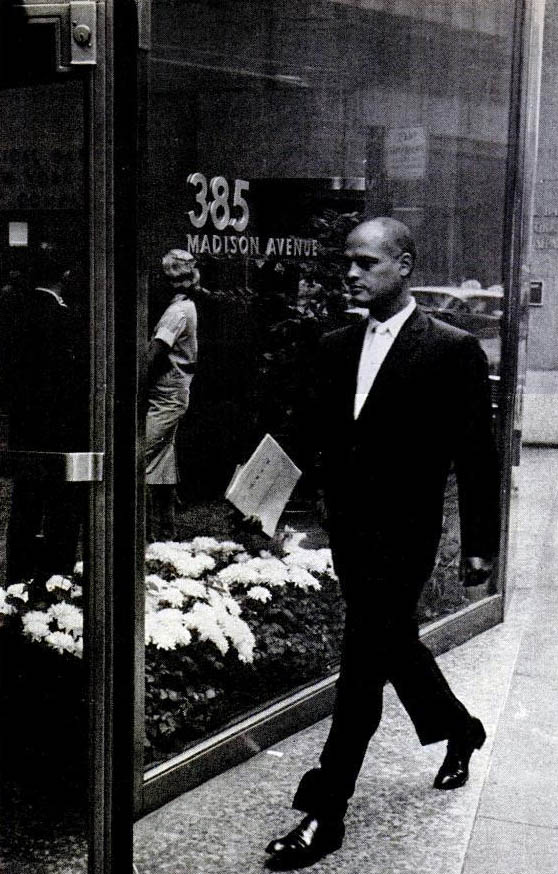
Only recently did I discover the existence of two African American advertising pioneers: Georg Olden and Archie Boston. As a VP senior art director of McCann-Erickson in New York, Olden was one of the first African-American executives in a major advertising firm. One of the original ‘Mad Men’ he was a leading artist and graphic designer and won numerous major advertising awards and recognized by AIGA.

Although many have forgotten his name, he developed many of the graphical techniques that became standard in the TV and advertising industries. He not only won several Clio Awards, but also designed the actual Clio statuette and is cited as having been involved in the design of the the famous CBS logo.

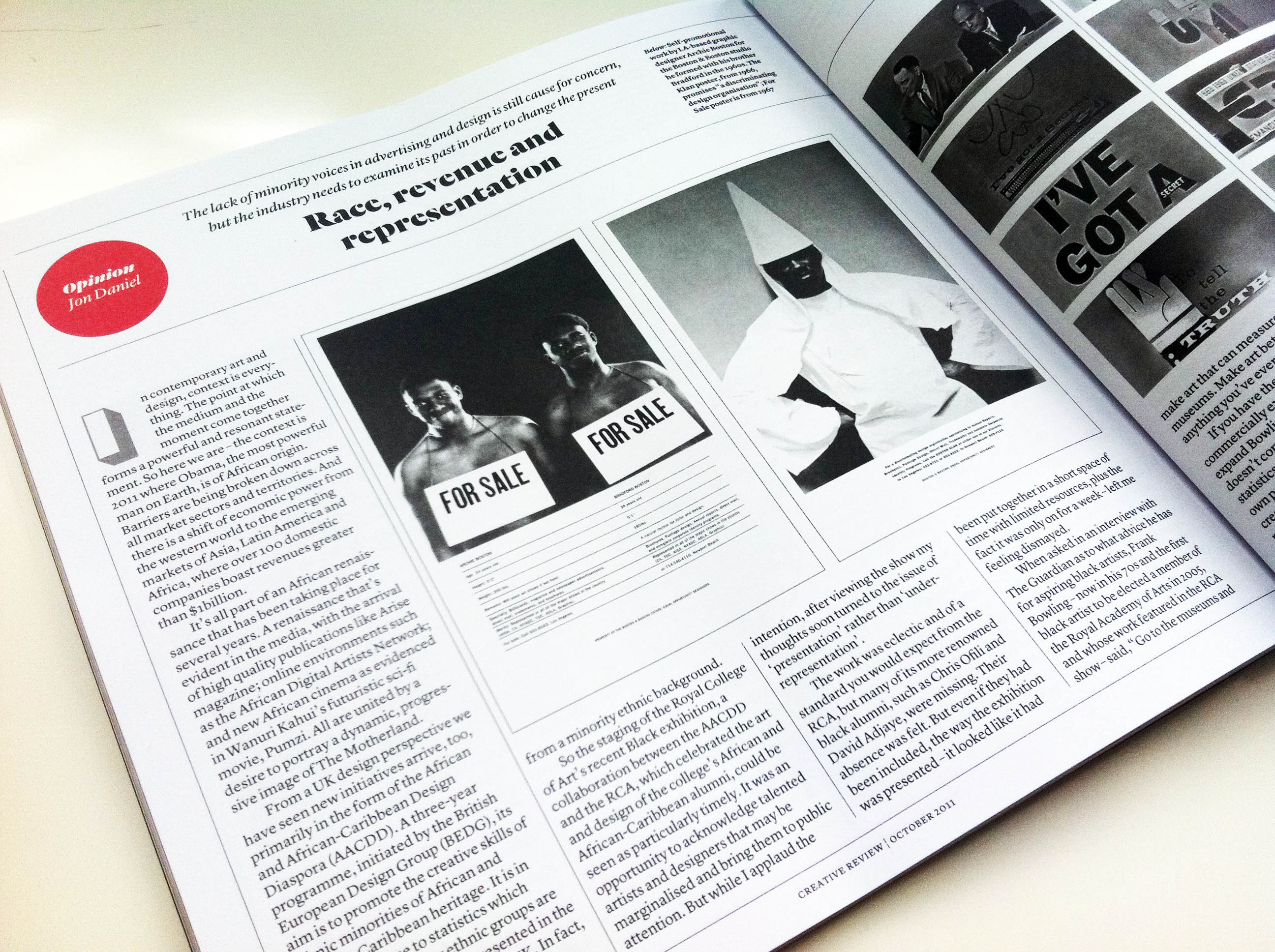
Another design pioneer, Archie Boston, then emulated Olden’s success. A nationally recognised art director, designer, author and educator, who in 2007, was the first African American to receive the prestigious AIGA Fellows Award from AIGA Los Angeles.

Boston comes from a time often referred to as the Golden Age of advertising. In the sixties he rolled with many of the biggest players such as Saul Bass and Louis Danziger, both design legends who personally did much to champion the inclusion of African-American graphic designers in their practices.

I had the pleasure of speaking to Boston about the issues faced by his generation and what he felt were the issues facing black designers today. “The challenges were much greater for us then, than they are now,” he recalls. “There was a time when I worked for a whole year on a project and never saw the client because the firm were worried about them realising the work was being done by an African-American.”

But now, Boston suggests, “the biggest challenge is motivation, in spite of all the problems that exist in society, to be strongly motivated enough to say, ‘I know I can do it and I’m going to work very hard to do it’. There are so many distractions,” he continues. “And now with the challenges of unemployment – there just aren’t as many jobs as there used to be – the profession is changing and you have to be adaptable to change with it.”

Boston’s words resonate with me because I can see how easily lack of motivation, plus lack of opportunity, plus lack of connections can all add up to suggest why there is a lack of ethnic minorities in the industry.

In an ideal world, we wouldn’t need to highlight the talents of a particular group or community: they would be included naturally as part of a global show of talent. But it is not an ideal world. Sure, we have role models. But they never seem to be held up quite high enough, or long enough, for all to see.

– Jon Daniel.