Tag Design

4 Corners: An Interview with Barrington Braithwaite

This month we head to a very unique part of the Caribbean, Guyana. It is unique in the fact that it is not an island, but a sovereign state situated on the northern coast of South America. Historically known as the ‘Land of Many Waters’, its heritage can be found flowing through the veins of many notable people, including Baroness Valerie Amos, Lord Herman Ouseley, the late Bernie Grant MP, David Lammy MP, Trevor Philips and pioneering US activist Shirley Chisholm. Many artists and entertainers have roots in Guyana, such as the distinguished playwright, poet and author John Agard; British-based actors Norman Beaton, Carmen Munroe, Ram John Holder and Cy Grant; and musicians such as Phil Lynott,, global superstar Rihanna and Eddy Grant, the platinum-selling musician and entrepreneur. It was Eddy who first mentioned the name of this month’s profiled creative to me, speaking with pride and reverence about the work of his fellow countryman. And who similarly I am proud to bring to your attention now. Introducing the graphic artist and illustrator, Barrington Braithwaite.

What’s your background?

I’m from roots that have produced folk in the arts and media. It’s kind of infra dig though, to talk about folks when the discourse is about self. I spent the formative years of my life with my godparents at Mahaica, rural Guyana, after my Adam and Eve went separate ways. There I was given the opportunity as an only child in their care to explore my imagination. My godparents encouraged my interests and only after their deaths did I realise that I had a privileged initiation to life – I actually have five sisters and four brothers. I was lucky that the Forbes Burnham post-independence Government of the 70s was developing youth-training organisations and bringing experts from overseas in different fields to train the youth of that period. I was interested in art or, I should say, I was compelled by this passion. However I became part of a young settlers co-op group after school in 1974 and there did courses in co-op management and field practices. The Cold War temperature was impacting on Guyana, I left the co-op and worked on the waterfront to survive, until I was encouraged in around 1981 by my friend ‘Fat Boy’ Herbert Archer, a poet, to take my portfolio – which wasn’t much – to Dr Denis Williams at the Walter Roth Museum of Anthropology to negotiate a way out of the dog-eat-dog waterfront world. He engaged me and placed me through the training of a scientific illustrator, but I couldn’t help who I was and while on one particular archaeological site in the Northwest of Guyana’s Rain Forests, I wrote my first two stories to be illustrated. I was supposed to go to Scotland to complete my training but it was decided that if I went I wouldn’t return, so disgruntled I left the museum, and worked freelance as a commercial artist at the Guyana Chronicle. With the support of editors I developed and published several comic strips and serials. With a young family I started an advertising service to keep the pot boiling, and have maintained that while developing and self publishing my graphic magazines.

How did you get started in your field of expertise?

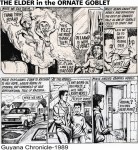
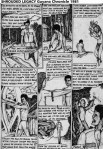
As far back as I could remember I was enthralled by comic books and most of all telling stories using that medium. While in school I became the class artist. This fame extended even to higher forms, from helping with class art assignments to doing rip-offs of commando comic books in four-page exercise-book middle-page pull outs. These were sold for a penny. I had to wait until 1981, when I was employed by Denis Williams. I presented him with an illustrated story I had done named The Shrouded Legacy. He took me and my story down to the national newspapers who I think he bullied to accept it, and I was guided through my first contract and received my first cheque. When it hit the Sunday pages I received in the weeks that followed great harassment from friends who then pointed out my errors which were many. I had used the only drawing pen I had, didn’t understand the concept of lettering or word balloons and was not a good artist qualified for publishing by the standards of the day. Eerie, Creepy and the Warren Publishing line had enveloped our horizons. I prayed for my series to finish and the torment to stop. I did not fold up and it took years with my wife as the female model and some old muscle magazines for the males to develop my skill, this was a weird mix and with the critical help of my buddy Andy Anderson I emerged with the Elder comic strip, that through negotiations the newspapers carried. As I said before, the policy of the Government back then was to encourage the local arts, but there were standards to be met. I had decided by 1983 to develop a medium for the talents that were directing my thoughts. I had no idea at the time of the necessary independent support systems that were needed to make this happen, I concentrated on making my artwork meet the acceptable standards. In 1988 I published the trilogy of The Shadow of the Jaguar. In the ‘90s I wrote and illustrated The Legend of the Silk Cotton Tree – this went from graphic magazine to stage play in 2010. I work under the Company Name Spectrum Creative Productions and administrate a small advertising service, and have done work for UNICEF, the West Indian Cricket Board and other agencies. The goal of a pure graphic magazine publishing outfit continues to propel the production of several new projects that are yet to be published.

What challenges did you face in getting into the industry and achieving your ambitions?

There is no publishing industry in the CARICOM belt and the comic book industry is even further away from this reality. The most unexpected and vicious opposition to my work as a self-publisher did not come from competition, but from those who had appointed themselves the custodians of proper culture in Guyana. These were characters that were more British than the English who had ruled British Guiana. The idea of an Afro Guyanese hero was offensive I think to both the caricature class and the PPP government. The Shadow of the Jaguar strip in the National Chronicle Newspaper was dropped after the PPP Government was elected in 1992. I had long concluded that Guyana was not the world and since I had always trained my art along the guidelines of a holistic illustrator’s universe, I proceeded now as artist activist resident in my country. The challenges also lay in understanding the rules of protecting one’s work on the international market place, and having a working understanding of contract law. With the rise of new technologies to apply that to production, also charting a network for collaborations wherever the veins progressively lead. Venture capital has always been the unpredictable Cerberus, from a working-class hemisphere talent as me. Cultivating and honing one’s talents and creative skills were the first of the labours, next lay the support forces, space for work, raising a family and no external finances, rising above this is a task of pure will. Only the perseverance, the muse that from its inception was the driving force, delivers the irrational incentive to face these factors towards the realisation of the real fulfillment that is having the complete means present to publish as I see fit the full studio of works that encompasses the last 35 years.

Who and what are your greatest inspirations and influences?

I was enthralled by the Sunday cartoons and comic books and I had inherited artistic and the scribe’s talent. Then my greatest influences came from the debates in my father’s workshop about local legends, aspects of Caribbean history, Biblical accuracy against movie stuff and other subjects that preoccupied my serious conversations into early manhood. Some of these subjects required research, like when I thought [at about ten years old] that the Ten Commandmentsmovie reflected things that had happened in Spain – it isn’t funny bro. Reading brought me new ideas and information and in discussion with my peers they rebuked me that I should do comic strips about our topics – a herculean task, but an inspiration. Realising that my talents can fill a vacuum with edutainment tales and characters was the greatest inspiration that propelled me into this career.

What is the project you are most proud of?

I would like to think that I’m currently working on my most valued project. I first attempted the current project, which in its concept presents WWII and then links it to other historical epochs in a mystical way, because this project has some moons to go – I can’t get into the details. What I can say was that I started it around 1984 and I had shown Dr Williams the first concept issue. He proposed to purchase it for the Department of Culture’s Library, I was been trained as a scientific illustrator and was finding it difficult to survive on the Government’s stipend. He then asked me where I was taking the story, what were the elements I wanted to explore? I explained to him what I wanted to do, what had gripped my imagination. He shook his head and explained to me that I should give the ideas about 20 years to grow because I didn’t have the information at the time, he asked me some questions, to which I replied, he then answered them for me to illustrate his point then assured me not to bother with Hollywood and to cover both African and European history deciphering the in-between propaganda that is inserted in historical works, by cross reading. Reading that included the metaphors of the mystery systems, and Dr Williams concluded prophetically, that I’ll know when I’m qualified to address the topic. Yes I was pissed, but convinced by his questions and his counter-answers that I didn’t know as much as I thought, to do this work of fiction. I was mentally oriented that I must be conditioned to face the exploration, and exploitation of ideas with an understanding of the subject, whether it’s the geography, architecture or costumes. With the medium of graphics one has to come close to accurate. The origins of conflicts cannot be taking for granted either. For example – the current Ukrainian issue, where did it start, was it in the Middle ages, the Stalinist era, or with the Nazi era? A framework for a fictional work has to be grounded in a mythic or historic reference sphere , from there, the poetic license can be applied. So that attitude towards work compels research for development and if you’re operating outside of a major budget , then the work is on you and it will take time, lots of time. Dr Williams was right; I couldn’t do honest work on the subject matter of the graphic series now in progress without a wealth of historic time travels, and a working knowledge of religious beliefs across migrations into their modern innuendos. Because it’s not yet protected I can’t provide insights, except to say it’s my pet project. I’ve just finished a recent pet project that I’ve been working on for years, a graphic novel on the Haitian Revolution, a whopping 123 pages, hand coloured and compartmented into five sections. From the period of composing the first page, outside of the years of research, it took three years to complete and now it’s the stuff of nerves to work out the deal that will take it to pay-day. This can be considered my current showpiece, because it was never done before. But as time goes the showpiece changes with the season.

What would be your dream project?

The greatest achievement as a job for me is to be able to work on set designs and costumes for one of my graphic works turn into a movie, then with enough money I’ll finance research into a lens that can peer into the stuff dogs howl at.

Who in your field that you believe deserve credit or recognition?

That list would begin with my parents, whose genetics gave me a certain persuasion, then my muse, who’s out there and whispers and guides in some uncanny, save the moment coincidences, I’m still searching the science magazines on the data of the human brain to see if they’re any clarifications that suit my muse experiences – none so far. Mr Hunter, the head master of the school I attended on the rural east coast of Demerara in my formative years, was a tremendous influence. My godparents Abel Burke and Elizabeth Cumberbatch, who raised me in my formative years until their demise when I was about 14 years old, had indulged my curiosities for toy soldiers, comic books and had engaged me in conversations about the travels of Odysseus and Aesop’s tales, they can be credited with shaping the foundations of my later creative career development. My buddy Andy Anderson, who was my personal critic on the evolution of my art, the long after-school debates on technique in the Art room of Queens College. My Mother Grace lived outside of Guyana, my father was the resident parent, and Hubert Braithwaite never stood in the way of my boyhood interests, though he guided me towards the illustrated Classics and coerced me to read my first novel which was the Louis L’amour book ‘To Tame a Land ‘, my dad read lots of western novels,. he did subtly guide me towards Architecture and furniture design, he built houses and had a furniture making operation, which I found exciting but was mundane in respect to the creative stuff that was compelling me. My wife Donna and children Michelle, Taharka and Makeda who were all seconded for model services over the years, and as the photographer when I had to be the model for immediate anatomy fixes. They endured my on-the-job hastily applied lessons on the model or photography specifics, they snarled and scratched and I growled, until we got it done. When I started in the media, at the Chronicle there were people there who were interested in the unveiling of local graphic storylines, and there are names I must include: Claudette Earle the Sunday editor, Godfrey Wray another editor, Adam Harris, Frank Pilgrim and Ulric Captain, all managers at Chronicle, the latter who I was working with to expand to the Caribbean to have a general pull out graphic publication When the Government changed. My pal Poloma, now Professor Poloma Mohammed, a playwright and writer herself who was always there, and David Granger [Brig. Rtr] whose publications on local history gave me the opportunity to interpret much of our local history in graphics. These are the pivotal persons who have come to thought in related fields. And finally the late Poet ‘Fat Archer’, and the small businesses with an interest in the arts who always supported my graphic projects.

What’s your best piece of advice for those wanting to follow in your footsteps?

I would hope that certain systems are in place with the activism of myself and others to make the acceptance of the local graphic storyteller friendlier and with a greater respect for the value of the work produced. The road of the illustrator, painter, poet and writer is not an easy one, the more talented the artist is, will mean the more challenges, and with originality must come the strength to defend the new explored territory. Young aspirants to the graphic arts must understand that they’re embarking into a serious field, especially if they are going to write their own creative or documentary projects. They must, apart from honing their talents, mastering the areas of anatomy, materials and technique, have a historic understanding of the evolution of the field, from the caves to the current top guns, whose work continue to inspire and move us onto our own. For me it was the unknown artists who did the Commando comics, then on the local Guyana scene it was Rudy Seymour who did the first local comics I knew. I later engaged the work of Tom Feelings. Frank Frazzeta , Bernie Wrightson, Will Eisner all came after I had the gift of Treasure Island illustrated by Newell Wyeth. Old magazines led me to the French and Europe, Eugene Delacroix, Dore’ and the guy who in my view jump-started the modern fantasy art trend: William Blake. But this reservoir of knowhows about the field wouldn’t be enough. The practicing artist has to understand the legal world of copyright, to protect from being sued for violating the commanding piece of art or photography you adopted verbatim into your stuff, or if the situation is vice versa, then copyright becomes your best friend. This wouldn’t be complete without a working understanding of contract law. Contract law is a significant crossroad process that will build or break you – from experience I can tell you this. Your talents can work for you or for some other wiseguy, based on what you know when you leave the environs of your muse and enter the entangling vines of the rainforests out there.

What’s next for you?

The next limb on the tree of life I’m reaching for is for the fruit that enables me to launch internationally the pivotal four graphic series I want to place on the market, this would entail the cash-flow to recruit back-up talents and publish the first two unhindered, then the other two series mentioned. This would open the door to introduce, based on the response of license relationships solicited or attracted explorations into comparative mediums, that would allow realising the exploration of other latent ideas for different audiences. Without further whimsical elaborations, the above capture what lies ahead.

A very special thanks to Patrice Hinds for his help in facilitating this interview.

Network

THE U.S:

Serigrafía surveys the powerful tradition of information design in California’s Latino culture, featuring thirty influential silkscreens from the 1970s to the present. Beginning in the late 1960s, graphic art created at and distributed by artist-led collectives, or centros, contributed significantly to the public discourse. Emerging in concert with the civil rights movement and demanding political and social justice for marginalized groups, these prints confront political, economic, social, and cultural issues on both a personal and a global level. Runs until April 20, 2014 at Pasadena Museum of California Art. For more information visit http://www.pmcaonline.org/

THE CARIBBEAN:

Rincón International Film Festival. On a mission to support and promote culture and the arts in Puerto Rico through the medium of film, the festival seeks to inspire student, future and current filmmakers in the art of filmmaking.From7-13 April 2014. For more information visit http://www.rinconfilm.com

EUROPE:

Japanese Poster Art : Cherry Blossom & Asceticism. Intended as a cultural contribution to the 150th anniversary of the establishment of diplomatic relations between Japan and Switzerland, the exhibition presents the history of the poster in Japan, where this medium is primarily known as an artistic statement and image advertising. Works by three old masters, Shigeo Fukuda, Kazumasa Nagai and Ikko Tanaka – from a generous donation to the museum – are to be seen alongside posters from 1950 to the present day. Here the special aesthetic of Japanese graphic designs reflects the dialogue between Eastern and Western visual culture. Runs until 25 May 2014 at Museum für Gestaltung Zürich.

3rd Curacao International Film Festival 2014. 2 – 6 April 2014 at The Cinemas Curaçao‎
1 Baden Powellweg
 Willemstad, Rotterdam. For more information visit thecinemascuracao.com

AFRICA:

Fashioning Africa is set to bring some of the continent’s most exciting contemporary designers to Johannesburg. The multidisciplinary exhibition explores the history of African fashion and surveys the current landscape of fashion in Africa. The exhibition runs until 27 April at the Museum of African Design. Admission: R 30
 Museum opening hours: Tuesday – Sunday, 10.00am – 5.00pm. For more info visit http://www.moadjhb.com

Nine Fine Design Pioneers

This month, in recognition of the US celebration of Black History Month, Four Corners breaks from convention to profile not one person, but nine people. Taking a moment to reflect on some of the historical achievements of African-American creative pioneers. The short biographies presented can in no way do justice to these esteemed people, but instead are designed to stimulate your natural curiosity to look further into the contribution made by these extraordinary men and women. Although all of the people featured here are no longer with us, they each made an indelible mark on the cultural and creative landscape and blazed a trail for others to follow. #Respect.Stamp featuring Madam CJ WalkerStamp featuring Madam CJ Walker

Sarah Breedlove, aka Madam CJ Walker, cosmetics designer, marketer and entrepreneur (1867-1919)

Way, way before Oprah, there was Sarah Breedlove, or Madam CJ Walker as she is more commonly known. The first child in her family born free from slavery just after the Emancipation Proclamation was signed, this incredible woman made her fortune designing, developing and marketing a highly successful range of beauty and haircare products for black women via the business she founded, Madam CJ Walker Manufacturing Company. Regarded as the first US female self-made millionaire, Walker proved herself to be a great philanthropist, using her wealth to support many black organisations such as the NAACP plus a number of schools, orphanages, individuals, and retirement homes. Her achievements have been celebrated by many prominent institutions, most notably, The National Women’s Hall of Fame and on a postage stamp as part of the USPS Black Heritage USA series. For more information visit www.madamcjwalker.com.O, Sing a New Song (1934), by Charles DawsonSource: University of Illinois  O, Sing a New Song (1934), by Charles Dawson

Charles Dawson, illustrator and designer (1889-1981)

As one of Chicago’s leading black artists and designers in the 1920s and ’30s, Charles Clarence Dawson made his name creating illustrated advertisments for beauty products and many of the major black businessmen and entrepreneurs of the day, including the pioneering black filmmaker, Oscar Micheaux. Born in Brunswick, Georgia to hard-working parents, and a student of Booker T. Washington’s famed Tuskegee Institute, he more than paid his dues working a variety of odd jobs to pay the tuition to become the first African American admitted to the Arts Students League in New York. He later went on to attend the Art Institute of Chicago, was a founding member of Chicago’s first Black Arts collective (the Arts & Letters Society) and an integral part of the New Negro Movement in the visual arts or more commonly referred to as the ‘Harlem Renaissance’. For more information visit www.aiga.org/design-journeys-charles-dawson.Into Bondage (1944) by Aaron Douglas, at the Corcoran Gallery of Art, WashingtonSource: Sarah Stierch  Into Bondage (1944) by Aaron Douglas, at the Corcoran Gallery of Art, Washington

Aaron Douglas, illustrator and designer (1889-1975)

Another leading figure and architect of the Harlem Renaissance, Aaron Douglas’ bold geometric and angular illustrations alongside the philosopher, Alain Locke’s insightful prose, featured prominently in the landmark 1925 publication, The New Negro. His work enabled the formation of a new visual language that embraced a distinct African heritage. It was a style that found its way onto many a publication cover and would later become known as ‘Afro-Cubism’. His work also translated beautifully into designs for wall murals, the best example of which is calledAspects of Negro Life’ created in 1934 for the 135th Street branch of the New York Public Library, or as it is now called, The Schomburg Center for Research in Black Culture. For more information visit www.aiga.org/design-journeys-aaron-douglas.The Theme Building at Los Angeles International Airport (1961), Paul Williams was consulted on the designSource: brew books The Theme Building at Los Angeles International Airport (1961), Paul Revere Williams was consulted on the design

Paul Revere Williams, architect (1894-1980)

At the height of his career, Paul Revere Williams was popularly described as the ‘architect to the Stars’. This is an incredible accolade and achievement, not least for someone who was orphaned at a very young age, but also as a African American growing up through times of some of the most overt racism imaginable. In spite of all this, and encouraged by a foster mother who nurtured his education and artistic talent, he let his work ethic and perfectionist nature speak for itself. Earning academic awards, winning competition prizes and the respect of  both colleagues and clients along the way, he founded his own architectural practice in 1922 and became the first African American member of the American Institute of Architects in 1923. For almost 40 years, his home designs were commissioned by the Hollywood elite of celebrities, movie stars and powerful and wealthy Californian individuals. For more information visit www.paulrwilliamsproject.org.Pan American Unity Mural (1939), created by Diego Rivera with Thelma Johnson-StreatSource: Joaquin Marinez Rosado Pan American Unity Mural (1939), created by Diego Rivera with Thelma Johnson-Streat

Thelma Johnson-Streat, painter, illustrator, muralist and textile designer(1911-1959)

Against all the odds, this exceptional African American ‘Renaissance-woman’, gained recognition from an early age through her Art. A passion, which she expressed through many different channels and subsequently gained recognition for all of them. Whether working with celebrated Mexican muralist, Diego Rivera; becoming the First African-American woman to have her work exhibited in the Museum of Modern Art, New York; as a teacher and activist promoting cultural diversity through art; or performing a dance recital for the King and Queen at Buckingham Palace in the 1950’s; it was all done with her customary grace, style and sophistication. For more information visiten.wikipedia.org/wiki/Thelma_Johnson_Streat.Emancipation Proclamation stamp (1963), by Georg OldenEmancipation Proclamation stamp (1963), by Georg Olden

Georg Olden, designer and art director (1929-1975)

A man very much after my own heart, Georg Olden produced outstanding commercial work for some of America’s biggest corporations. As CBS’s Head of on-air promotions, in the early days of television, he pioneered the field of broadcast graphics, supervising the identities of programs such as I Love Lucy, Lassie and Gunsmoke, under the wing of leading art director, William Golden. If that wasn’t enough, he turned his attention to advertising, winning shelfloads awards and mentions in Graphis and Art Directors Club annuals continuously. In fact, the Clio Awards statuette of which he won several, was designed by him in 1962. He was the first black American to achieve an executive position in major corporation and also went on to become the first African American to design a postage stamp; a broken chain commemorating the 100th anniversary of the Emancipation Proclamation. Not bad going for the grandson of slave. For more information visit www.aiga.org/medalist-georgolden.Mr Magoo. The Mr Magoo animated series was directed by Frank BraxtonSource: Kevin Dooley Mr Magoo. The Mr Magoo animated series was directed by Frank Braxton

Frank Braxton, animator (1929-1969)

Let’s paint the scene. America. The 1950s. And Jim Crow laws of racial segregation are still in place. How the hell does a black animator get his foot in the door as an animator at Warner Bros Animation? Well, the story goes that animator Benny Washam walked into the office of his production manager Johnny Burton and said, ‘I hear Warner Bros. has a racist policy and refuses to hire blacks.’ A furious Burton wheeled around in his office chair and shouted, ‘Whoever said that is a liar! It’s not true.’ ‘Well then,’ said Washam, ‘There’s a young black animator outside who’s looking for a job. Guess he’s come to the right place.’ That man was, of course, Frank Braxton, who went on to become part of the team at the legendary Chuck Jones unit at Warners. Many of Jones’ amazing cartoons of the 1950’s would contain substantial contributions from Braxton. He also served as a director for The Bullwinkle Show, Mr. Magoo, Charlie Brown TV specials and early Cap’n Crunch  commercials. For more information visit jimhillmedia.com/columnists1/b/floyd_norman/archive.US Embassy in Tokyo (1976), designed by Norma Merrick SklarekSource: jarsyl US Embassy in Tokyo (1976), designed by
Norma Merrick Sklarek

Norma Merrick Sklarek, architect (1928-2012)

As a first generation African-American, born in Harlem to Trinidadian parents, Norma Merrick Sklarek would go on to accomplish many more ‘firsts’, building an unparalleled career as a pioneering women architect. She became the first African-American director of architecture at Gruen and Associates in Los Angeles in 1966. Sklarek became the first black woman to be elected Fellow of the American Institute of Architects in 1980. In 1985, she became the first African-American female architect to form her own architectural firm: Siegel, Sklarek, Diamond, which was the largest woman-owned and mostly woman-staffed architectural firm in the United States. For more information visiten.wikipedia.org/wiki/Norma_Merrick_Sklarek.Fairchild Channel F (1976), designed by Jerry LawsonSource: Mulad Fairchild Channel F (1976), designed by Jerry Lawson

Jerry Lawson, video games designer (1940-2011)

His name may not be as synonymous with the gaming industry as PlayStation and Nintendo, but Jerry Lawson’s innovative technological design and engineering work helped pave the way for them to follow. For Jerry made history when he created the first ever cartridge-based video game console, The Fairchild Channel F. Hailing from humble beginnings in a housing project in Jamaica, New York, his passion and talent for technology was to take him far, becoming Head of the Fairfield Channel F project where he and his team designed many of its prototyped components. Always looking to push the systems capabilities beyond just cartridge gaming, they put together a daring initiative called TV Pow, which was the first, and only video game played via broadcast television. For more information visitclassicgames.about.com/od/classicvideogames101/p/JerryLawson.

Network:

THE U.S:

Acasa 16th Triennial Symposium On African Art at the Brooklyn Museum will consider the full range of topics related to the arts of Africa and the African Diaspora currently being addressed by ACASA members, from considerations of the archaeological and archival contexts of historical African art to examinations of emerging artistic practices on and off the continent. Like the accomplished Lega elder who once used a three-headed sakimatwemtwe figure, ACASA members look to the future and the past, simultaneously. For more info visit www.acasaonline.org

THE CARIBBEAN:

Bermuda International Film Festival (BIFF) 2014. Since its inaugural Festival in 1997, BIFF has remained steadfast in its mission statement: to advance the love of independent film in a community welcoming to filmmakers and filmgoers and to encourage and inspire young Bermudians to capture their very special narrative through the lens of a camera. This year’s festival runs from 21-27 March.  For more information visit www.biff.bm.

EUROPE:

Still Fighting Ignorance & Intellectual Perfidy: Video Art From Africa presents a selection of African video art that stands beyond the clichés that remain associated with the dark continent and the postcolonial image. It seeks to bring viewers closer to idiosyncratic readings of African video art and its thematic concerns, which are largely ignored. Runs 13-30 March at BEN URI Gallery & Museum, London, United Kingdom. For info visitwww.benuri.org.uk.

“Haute Africa” – At Photofestival Knokke-Heist 2014. From March up to June 2014, Knokke-Heist will once again focus on contemporary photography. The highlight of the festival is the outdoor exhibition, entitled “Haute Africa”, in which international leading artists and photographers such as Martin Parr, Wangechi Mutu, Zanele Muholi, Viviane Sassen, Yinka Shonibare and many others offer an alternative perspective on the contemporary African continent.For more info visit fotofestival.knokke-heist.be/en

AFRICA:

‘Du Bois in Our Time’ Final presentations of works by Ghanaian and UK artists, Bernard Akoi-Jackson, Adwoa Amoah, Ato Annan, Yaganoma Baatuolkuu, Serge Clottey, Kelvin Haizel, Kwesi Ohene-Ayeh , Mawuli Toffah, and Mary Evans. Mullti-media and site specific works will be presented in the Du Bois Museum and Mausoleum after several months of reflecting on the legacy of civil rights leader and Pan-Africanist, W.E.B. Du Bois, in our present era.
Opening events will include a discussion, talk with artists and scholars, poetry and workshops over the 2 days. The entire programme of ‘Du Bois in our time’ Accra was sponsored by the Art Mentor Foundation Lucerne. For more info visit www.nubukefoundation.org

If you have any forthcoming events that you would like to be considered for inclusion in this column, please do not hesitate to contact me by email at info at jon-daniel dot com.

A Super Hero Identity Crisis

poster-supermanreveal

Lately, I have been thinking a lot about ‘superheroism’. Partly, because of my Afro Supa Hero exhibition currently on display at the V&A Museum of Childhood, that is centered around my personal collection of African diaspora pop cultural action figures and comics; but also because I see it as a theme that is gradually becoming more visible in society. A trend, I believe is primarily due to the phenomenal rise of gaming across all different platforms and devices. Virtual worlds offering momentary escapes from our real lives through new identities, avatars and alter egos. Sophisticated pursuits that are no longer purely the preserve of children, but also taken through to adulthood.

Although, I am not a big ‘gamer’ myself, I find this whole subject fascinating, especially when I relate it to the African-Caribbean experience in the UK and how many people of my generation; the 1960s first generation Britons, born of Caribbean parents; spent years searching for their own identity.

Even though a sense of displacement was something we shared with our ‘brothers and sisters’ in the Caribbean and the US, I believe our experience in Britain was quite unique. The patriotism, they showed for their respective countries, was a feeling that was often completely alien to me and many of my peers.

Here, we were a group of citizens who felt no more at home in the country of our birth, than we did in the homeland of our parents. In Barbados I was called a ‘Little Englander’ yet in Britain I was seen as a ‘bloody foreigner’. It was an identity crisis that took me years to come to terms with, and even to this day, I still tend to identify more with being a Londoner first and foremost, than being British.

It is experiences like these that have pushed me throughout the course of my life, starting in my early teens, to explore and embrace African Diaspora history and its legions of super heroes and heroines. It fuels my belief that uncovering the truth in ‘History’ is the great equalizer that can help address many of the negative perceptions that surround race, religion, sexuality and gender.

It also informed the approach that I took in creating my Afro Supa Star Twins™ that adorn my exhibition branding and merchandise.  From the outset, I wanted my characters to be accessible to everyone. I was deliberate in making them twins, one male and one female because of my belief in harmony and the equality of the sexes.

In terms of the Afro style, on one hand, and purely for selfish reasons, it embraces the main phase of my childhood; but on the other it was also a dynamic time of ‘Black self-pride’ and ‘Afro-consciousness’ as the formality of the 1960s civil rights and counter-culture movements, paved the way for the free form funkiness of the 1970s.

Although certain strides have been made in the depiction of black cultural heroes and heroines, one issue that still continues to linger is the assumption that a white super hero is for everyone, yet a black super hero is only for black people.  Actually, the ultimate global super hero right now should be from the Han Chinese community, if we are to take our cue from the latest global population statistics.

If we are to go by history, and embrace the scientific facts that suggest all life on the planet came out of Africa, then a super hero of African origin is an entirely fitting concept to be embraced by all.

I have no doubt, the continued portrayal of the white super hero savior of humanity is down to the historical legacy of racism and the continued white male dominated power structure within the worlds of media, television and film. Maybe once they are finally able to accept the ancient African roots of their identity, the world will be a better place for us all.

4 Corners: An Interview with Jepchumba

This month we journey to east Africa and the nation of Kenya, named after Mount Kenya, the second highest mountain in Africa. It is in this country, we find a young intrepid woman who has scaled heights and accomplishments beyond her tender years. Listed by Forbes as one of the 20 Youngest Power Women in Africa 2012 and by the Guardian among Africa’s Top 25 Women Achievers, she continues to be a cultural ambassador speaking around the world and promoting her commitment to creativity, art and technology. A mission, exemplified by her own background as an African digital artist (with experience in digital art, web design and development, audio-visual production and social media strategy) and which led her to create the dynamic African Digital Art online platform. This is a collective and creative space where digital artists, enthusiasts and professionals can seek inspiration, showcase their artistry and connect with emerging artists. It is my pleasure to introduce you to the artist known simply as Jepchumba.Jepchumba

Jepchumba. Cultural explorer, ambassador and curator

What’s your background?

I am originally from Kenya, but I have lived all around the world. I am always interested in the intersection between creativity and technology. I am a digital artist and also the founder and creative director of African Digital Art Network.African Digital Art

African Digital Art

How did you get started in your field of expertise?

I have always had an interest in design and multimedia but I took a detour into political philosophy, majoring in critical social thought. It was difficult for me to communicate my ideas with words but I was inspired to describe my thoughts and ideas visually. I soon became obsessed with digital media, finding a new playground where I could easily translate my ideas into life. I pursued a masters in digital media and soon created and founded African Digital Art, a creative space dedicated to digital media enthusiasts and professionals from Africa.

What challenges did you face in getting into the industry and achieving your ambitions?

When I began there were not many known African digital artists. African digital art was not recognised. This was the impetus for me to create my own platform. It was difficult as a digital artist myself to find contemporary African inspiration and identify with the projects that were profiled internationally. African Digital Art has now become a source that not only inspires me daily but Africans across the continent and the world. It has been incredible to see African visual culture come alive online. Today I still have a personal struggle, mainly because of my role as a curator. It is difficult at times to step out of that role and dabble into my own projects. I think I am too self-aware and conscious of how my work is informed by so many great artists that I interact with. I have found that good periods of isolation can help inform my work so I consciously dedicate some time to spend offline so that I may develop as an artist on my own.Attack

Who and/or What are your greatest inspirations and influences?

This is an impossible question to answer. To be honest I am inspired and influenced by the artists that we feature on African Digital Art everyday. Just check out the site and you will see how hard this question is. I find myself going through phases where I immerse myself into different mediums – photography, film, animation. But I am fascinated by craftmanship and artisans as well, artists that deal with physical materials like wood and steel.

What is your best piece of work or the project you are most proud of?

African Digital Art remains today the best project or work that I have ever been involved with. I have witnessed how it continues to influence people from Africa who might have never been exposed to the possibilities that digital art and media provide. We have interviewed and featured thousands of projects from more than 32 countries in Africa and I am humbled by how much of a resource it has become to so many people around the world.Baobab

What would be your dream job or project?

I am currently obsessed with interactive art. My dream project would involve a large scale interactive art installation somewhere in Nigeria. I am a big fan of Nollywood and Nigerian movies. I love their outlandish story lines, dramatic visual effects – perhaps it is because I can be quite dramatic myself. It would be awesome if I could create an interactive installation that celebrated some of the great features of African film and television and the Nollywood industry.

Please name some people in your field that you believe deserve credit or recognition.

I have a great appreciation for the forefathers/mothers of film, art and photography in Africa. There a great many pioneers who revolutionised design, media and film by sharing their vision with the world. These are a few. Malick Sidibé – renowned African photographer; Saki Mafundikwa – Father of African Graphic Design; Moustapha Alassane – Father of African Animation; Ousmane Sembène – prolific African film-maker and writer; Bisi Silva – Curator of African Contemporary Art.Insomnia

What’s your best piece of advice for those wanting to follow in your footsteps?

The best advice is I can give is to constantly put yourself in environments where you are uncomfortable. It is important to stretch your limits and push past the boundaries of your creativity. Whenever you find yourself complacent or your work tedious and imaginative its time to make a move. Curiosity and discomfort have proven to be powerful tools that have shaped my career.

What’s next for you?

I hope to catch that flight to Lagos and do that interactive dream project.Hair

Network

THE U.S:

Changing America: The Emancipation Proclamation, 1863 and the March on Washington, 1963. The exhibition will be on view from Dec 14, 2013 to Sept 7, 2014 in the NMAAHC Gallery at the NMAH. It will be accompanied by a series of public programs and lectures exploring the social and political currents that shaped these events and their meaning to modern Americans. For more info visithttp://nmaahc.si.edu/Exhibitions/ChangingAmerica

THE CARIBBEAN:

Rebel Salute 2014 Music Festival Serving up a strict vegetarian menu complemented by a diet of cultural roots rap from Reggae’s finest. In tandem with this, is the concept of a drug-free, violence-free and non-alcoholic event. It is family event and children under the age of 12 are free. Due to the increase divergence of today’s music, events like Rebel Salute will give a children the opportunity to meet artistes and learn some of our music that are no longer played on our radio stations.  Takes place on the 17 & 18 January at Richmond Estate in St. Ann, Jamaica. For more info visitwww.rebelsaluteja.com 

EUROPE:

‘SPEAKER’ Vigo presents Zak Ové’s first solo show with the gallery following on from his recent participation in Glasstress at the Venice Biennale. Ové works between sculpture, film, painting and photography, often collaging the various elements using found, cast and recovered materials. He is interested in reinterpreting lost culture and mythology using modern and antique materials, paying tribute to both spiritual and artistic African and Trinidadian identities which have been given new meanings through Trinidadian carnival and the cross cultural dispersion of ideas.  Until 2 January 2014. Vigo Gallery, 21 Dering Street, London, W1S 1AL For more information visitwww.vigogallery.com   

OSPAAAL Posters Show Displaying a private collection of over 40 Cuban OSPAAAL posters. Kemistry Gallery, 43 Charlotte Road, Shoreditch, London EC2A 3PD From 5 December 2013 to 25 January 2014. For more info visit http://kemistrygallery.co.uk/ospaaal/

AFRICA:

The Future White Women of Azania Saga. A solo exhibition by Athi-Patra Ruga. One of a handful of artists, working in South Africa today, who has adopted the tropes of myth as a contemporary response to the post-apartheid era. Ruga has always worked with creating alternative identities that sublimate marginalized experience into something strangely identifiable. Among many notable creations to date has been the ambivalently gendered Beiruth, whose name, with its Middle-Eastern associations, evoked ideas related to Edward Said’s Orientalism and the Illuwane, again an ambivalent sexual entity rooted in Xhosa Mythology. But Ruga is now bringing a new set of mythical characters a little closer to home. In The Future White Women of Azania he is turning his attention to an idea intimately linked to the apartheid era’s fiction of Azania – a Southern African decolonialised arcadia. Runs from 27 November 2013 – 8 February. For more info visit: www.whatiftheworld.com  

If you have any forthcoming events that you would like to be considered for inclusion in this column, please do not hesitate to contact me by email at info at jon-daniel dot com.

SUPERMANDELA. Let the spirit live on!

Although I never had the privilege of meeting ‘Madiba’, I was fortunate to be in South Africa in 1994, just a month before South Africa’s first ever multi-racial elections since the Apartheid regime had finally been dismantled. At the time I was working professionally as an Art Director for a mainstream London advertising agency, Still Price Lintas; and embarking on my first foreign shoot to make a series of TV commercials in Cape Town. Tensions were running high from all sectors of the society, as no one knew what actions might emerge as a result of this new democracy. But on 10 May 1994 in Pretoria, Nelson Rolihlahla Mandela was inaugurated as South Africa’s first Black President. It was also around this time that I started building my collection of African diaspora action figures and comics. A collection, that I have been able to realise as an exhibition called ‘Afro Supa Hero’ and which is currently on display at the V&A Museum of Childhood in London until 9 February 2014.
'SuperMandela' © 2013 Jon Daniel. All rights reserved.‘SuperMandela’ © 2013 Jon Daniel. All rights reserved.
I actually came up with the idea for this image, ‘SuperMandela’ several years ago, but had never got around to putting it down until now. I believe much of the ethos of my ‘Afro Supa Hero’ concept is perfectly embodied in the spirit of Mandela. A man of such inner strength, wisdom, vision, courage, and conviction, he brought a divided nation together and commanded the world’s attention and respect. That’s power! Or in the words of the man himself, Amandla!

4 Corners: An interview with Bryan Bullen and Trevor Bullen

This month we head to the ‘island of spice’, Grenada. A beautiful, tropical idyll I am proud to claim as my maternal ancestral home. I visited Grenada three times during my childhood; the last time being in 1983, when I was 16, just after the US and allied Forces invasion (or intervention depending on your political point of view). Having weathered years of upheaval, either due to the internal forces of politics or the devastating external forces of Hurricane Ivan, I am genuinely excited at seeing this small and lush realm of the Commonwealth starting to blossom in many areas. From the heroic Victoria Cross-winning exploits of Sergeant Johnson Beharry on the battlefield, to the world-class performances of Kirani James on the sports field. Another field of expertise that may not be so readily associated with Grenada is architecture. And it is this discipline to which we turn our attention to now, and in particular a partnership that is at the forefront of Caribbean architecture and garnering a reputation for progressive work and design excellence. Introducing the award-winning talents of Bryan Bullen and his business partner and cousin, Trevor Bullen.Bryan and Trevor Bullen

Bryan Bullen & Trevor Bullen Founders, CoCoA (Caribbean Office of Co-operative Architecture)

What’s your background?

We are Grenadian, first cousins and have spent part of our formative years in the Caribbean, choosing to repatriate after a number of years living outside of the region. We were fortunate enough to have had the opportunity to train at renowned architectural schools in the United States (Bryan studied architecture at The Southern California Institute of Architecture and Trevor at Harvard). Additionally, we honed our skills through work experience in North America and Europe. Our decision to return to the Caribbean to practice has been shaped by our love for the islands, Caribbean people, and the quality of life which it offers. Our practice, which spans over a decade, has been an enjoyable but challenging journey. With our work, we are constantly testing, probing and exploring the many simple and complex issues involved in the making of architecture for the specific context where we live. In the early years of our practice we completed many residential, and commercial projects, however, our practice has grown to include the design of institutional and civic buildings, in addition to masterplans for larger projects. Our office has been fortunate enough to win architectural competitions over the last few years of which we are currently designing the new Grenada House of Parliament.Grenada House of Parliament

Grenada House of Parliament

How did you get started in your field of expertise?

If we are to dig deep into our backgrounds perhaps having both grown up in households with creative influences has been of primary importance. This has provided a very good platform for our development. Before studying architecture we have had prior experiences in the making of furniture, sculpture and objects which have taught us a lot about materials, building processes, and general methods of construction.  Our love for design and passion for creative work has fuelled our desire to engage in the practice of architecture where our creations can positively influence the lives of others, both at the micro scale of the individual and the macro scale of popular culture. We see this as both a privilege and a responsibility.

What challenges did you face/overcome in getting into the industry and achieving your ambitions?

This is a complex question as there are many challenges which we have encountered in our practice. On the one hand, there are the technical and construction challenges of living in a small place where we must contend with low-technology and the additional effort required for quality control during the building process. We are challenged to design our buildings to be efficient in terms of cooling and energy consumption due to the high cost of electricity. Quite often materials are not readily available, so a greater degree of planning is required in the execution of projects. Additionally, as most building materials are imported they are generally costly, requiring us to use local materials to cut down on costs. We have embraced this in our work, and where possible integrate local materials such as timber and stone in the design of our buildings. With the great push today towards creating green buildings with a low carbon footprint, although we promote such principles, our decisions are made for practical reasons and our desire to make sensible choices. Also on the technical side, the harsh tropical marine environment presents a challenge where on top of designing to suit the requirements of hurricanes, and seismic activity, the sun, sea and salt air are primary factors to overcome. With the practice of architecture in the Caribbean today much of the discourse is centered on identity and what is deemed an ‘appropriate’ language for regional architecture. Many regional architects have chosen to adopt a post-colonial language, which we do not necessarily subscribe to. Our pursuit has more to do with engaging the tropical environment, solving issues of the site and programme, whereby, the outcome and issues of tectonics and overall language is developed out of research, and experimentation which allows our buildings to be naturally shaped through this process. Much of the historical references in our work would be spatial referencing, for example, the idea of open-plan living and outdoor spaces such as verandas, or the allowance of air flow through our buildings facilitated by louvers, and the placement of the spaces which permits our buildings to stay cool, or be protected from the driving rains. In this case, the initial challenge for us was acceptance of our contemporary sensibilities, which as I said previously is generally outside of the typical post-colonial agenda.Jadrosich Residence

Jadrosich Residence

Who and/or What are your greatest inspirations and influences?

We are Modernist at heart and have certainly been schooled in this vein. That said, we do believe that our work should be grounded in its specific context. What interest us most are individuals whose work can provide solutions which express a pure thought and executed as such. Artist such as Robert Smithson, Richard Serra and James Turrel are inspirational. Many of the quintessential Modernist architects such as Le Corbusier, Mies van der Rohe, Oscar Niemeyer, Richard Neutra, Louis Barragan have all provided positive directions in the development of contemporary architecture that we have a great appreciation for. Some of the recent practitioners such as Glen Murcutt, Peter Zumthor, Aires Matheus also offer a lot in their practices. These architects are creating work which is deeply rooted their place, with a clear expression that transcends their localised conditions and speak to a wider global audience.Munding Residence

Munding Residence

What is your best piece of work or the project you are most proud of?

To pin-point one specific project is difficult as there are always decisions made over the course of designing a building, which we think – what if we had chosen to execute in a different way. We frequently discuss the evolution of our buildings from the time of construction to when they are occupied over years, and the changes they undergo. They can take on a life of their own, sometimes in ways, which we may not have expected. For example, when we visit some of our previous projects and see how the landscaping and gardens can allow our buildings to sit comfortably in the landscape, they can have a very different presence than when construction has just completed. Perhaps it is more important to focus on are the specific ideas and the solutions to problems. What gives us the most pleasure is to know that we have made the right decisions given the specific programs. The Munding residence is a case in point. Our first design for the project appeared a good solution and the client was very happy with it.  After visiting the site on numerous occasions and experiencing the force of the wind we revised the design by changing the exposed veranda space and swapping it for a protected courtyard. Additionally, we devised a double skin of sliding glass doors and operable vertical timber louvers, which allowed us to control the wind without compromising the view of the site. At first our client did not understand this decision, but thankfully he went along with it, and we know today that he appreciates that this decision was made as it has facilitated a usable outdoor space that the original design did not. What is most interesting for us was our decision to provide that the doors of the courtyard were designed to slide completely open creating a fluid space with the main living area. This expresses a great deal about our spatial sensibilities and our pursuit of buildings with open-plan living that we hope can be one with the tropical environment.Munding Residence

Source: Brian Lewis

Munding Residence

What would be your dream job or project?

A dream job would be one which our work can have a significant and positive effect on the lives of people. The project does not necessarily have to be a large facility as our current Parliament project, but, could be a small building, which can resonate and speak volumes in terms of its social impact. Our design for a beach changing facility is one such project – tiny in scale, but, with a strong iconic stature that is imbrued with deep cultural references. What is also enjoyable is the process of collaborating with other architects and creative people. We believe that the production of good architecture requires a team and understanding between the architect, owner and those who are involved in the building process. We have in the past collaborated with other architects, designers and artists, whom we feel have brought further richness and freshness of ideas to our projects which we appreciate very much as it adds greater strength and credence to our work.GBT Changing Facilities

GBT Changing Facilities

Please name some people in your field that you believe deserve credit or recognition.

The late regional architects, Roger Turton of Trinidad and Tobago, and Barrisford Wilcox who practiced in Grenada in the 1970s and ’80s. Both were extremely talented individuals with highly personalized styles. Their work exemplifies many aspects of open-plan living, good quality of indoor and outdoor spaces, and general compatibility of building with the natural environment. We very much appreciate their endeavor to create architecture that is suitable for its place, yet, not bounded by the restrictions of post-colonial rhetoric.

What’s your best piece of advice for those wanting to follow in your footsteps?

Practising architecture requires 100 per cent commitment and consistency of work on a daily basis. It is the everyday work, a step-by-step process that will be the most important over the long term of architectural practice. It requires patience, determination and self-belief. As difficult as this can be at times, it can also be rewarding to see your work come to fruition and have positive effects on the lives of people.Calabash Heaven and Earth Spa

Calabash Heaven and Earth Spa

What’s next for you?

As with all practitioners at this time, we are seeking out the many possibilities for work, and are constantly looking at our business model to ensure that we stay busy. We are currently engaged in the design of a series of case study houses.  Our intention is to partner with others within the building industry, including land owners and financial institutions, in an effort to get projects built. We are inquiring regionally and beyond for perspective jobs, which we can tender on.

Network:

THE U.S:

The Shadows Took Shape is a dynamic interdisciplinary exhibition exploring contemporary art through the lens of Afrofuturist aesthetics. The 29 artists featured in The Shadows Took Shape work in a wide variety of media, including photography, video, painting, drawing, sculpture and multimedia installation. Participating artists include Derrick Adams, John Akomfrah, Laylah Ali, Edgar Arceneaux, Sanford Biggers, Edgar Cleijne + Ellen Gallagher. Opens Nov 14, 2013 – Mar 9, 2014 Studio Museum of Harlem, 144 West 125th Street, New York, New York (212) 864-4500 For more information visithttp://www.studiomuseum.org

THE CARIBBEAN:

10th Annual Bahamas International Film Festival (BIFF) The Bahamas International Film Festival is a non-profit organisation dedicated to providing the local Bahamian community and international visitors with a diverse presentation of films from around the world. In addition to offering films that might not otherwise be released theatrically in the Bahamas, BIFF will provide a unique cultural experience and set of educational programs and forums for exploring the past, present and future of cinema.  Runs from 5-13 December 2013. For more info visit http://bintlfilmfest.com

EUROPE:

Patrick Lichfield’s Caribbean This is the first exhibition of Lichfield’s Caribbean images, many unpublished, representing all genres of Lichfield’s photography. Ends 7 December 2013. The Little Black Gallery, 13A Park Walk, London SW10 0AJ
For more info visithttp://www.thelittleblackgallery.com/shows/patrick-lichfields-caribbean

IN THE CITY  Graphic Design & Sound Art Exhibition P21 Gallery is excited to present In the City, an absorbing graphic design and sound art exhibition which provides a rare glimpse into four Arab cities. The exhibition will be a first of its kind in London to showcase a series of commissioned and pre-existing works from an eclectic line up of established and emerging Arab designers, illustrators, video, and sound artists. In the City transports the audience through four enigmatic, but overlooked Arab cities – Alexandria, Algiers, Baghdad and Nablus – by recapturing and reimagining elements of those cities. Runs til 15 December 2013
For more info visit http://www.p21.org.uk/inthecity.aspx  

AFRICA:

Native Nostalgia The Museum of African Design (MOAD) is excited to present its first full-length exhibition, running through 9 February. The group exhibition is an exploration of nostalgia in five African countries; Senegal, Nigeria, Algeria, Benin and South Africa. This exhibition tells the stories of bygone eras – positioning them firmly within present day narratives. Through architecture, construction, cartography, photography, communal archives, and historical reenactment, each artist and participant has a conversation with a past through which they did not live by juxtaposing design elements with those of today. Native Nostalgia explores both why young African artists are interrogating the continent’s difficult past, while also probing whether it is possible to be nostalgic for something one has not directly lived. For more info visit: http://www.moadjhb.com/visit/

If you have any forthcoming events that you would like to be considered for inclusion in this column, please do not hesitate to contact me by email at info at jon-daniel dot com.

4 Corners: An Interview with Lulu Kitololo

This month we focus on my hometown, London. As the first generation offspring of African-Caribbean parents born in the mid Sixties, I did not always find it easy to embrace my ‘Britishness’.

However, I’ve certainly never had any problems identifying myself as a “Londoner” – for London truly is the world within a single city.

Home to every conceivable nationality, this cosmopolitan metropolis pulses with its vibrant mix of cultures. And it is from this dynamism that the opportunity for new voices can emerge. New voices like those of Lulu Kitololo and her design company Asilia, whose work is not just resonating on these shores, but also beyond.

I have watched their work progress over the past few years with eagerness; appreciating its distinctly African roots whilst bringing a fresh modern approach and aesthetic.

It’s a design voice I really like, so let’s hear all about it from Lulu in her own words.Lulu Kitololo

Source: Jonathan Perugia

Lulu Kitololo

What’s your background?

I was born and raised in Nairobi, Kenya. I was always creating things as a child – constructing shelters indoors when the weather was miserable; making trains for my dolls out of fruit cartons; experimenting with food in the kitchen; ‘refashioning’ my dresses (much to my mother’s dismay) and; of course, making images on paper. My parents were generally very encouraging of these pursuits but, being that I excelled at all subjects in school, I don’t think they – and many others – were fully prepared for the decision I made to pursue a creative profession.

I went to art school, Pratt Institute in New York, not quite sure what to specialise in and I ended up pursuing a Communications Design degree with a major in Advertising Art Direction. Thereafter, I worked for a couple of advertising agencies but something about it just wasn’t for me.

I ended up going back to school, this time to pursue a Masters in African Studies at SOAS, University of London. It was a fantastic year – learning about African politics, culture, film and literature. There were several interesting responses I experienced from people at that time including, “but you’re African, why do you need to study Africa?” and, “what are you going to do afterward?”

At the time, I had no idea what I was going to do afterward but I was very content with what I was doing and had faith that a path would reveal itself. I stumbled across a design job with a sustainability communications agency, Futerra, and it seemed a perfect opportunity to combine my creative expertise with my interest in development. I worked there for over 3 years and then left because I yearned for the freedom of self-employment. I’ve since gone into business with a friend and our creative agency, Asilia will be celebrating 3 years later this summer. It’s been an amazing journey, creating a niche for ourselves on the back of our distinctive style; our presence in both London and Nairobi and; our journey into creating products as well providing creative services. I’m very excited about what the future holds for us.Film Africa print materials

Film Africa print materials

How did you get started in design?

The skills and knowledge I gained as part of my Bachelor of Fine Arts degree have been invaluable. However, the most significant thing I learned during those 4 years was not explicitly taught and that was – how to be resourceful.

I think resourcefulness and experience are great tools for any designer. Experience is something that comes with, well, experience. From my 2nd year of university, I was taking every opportunity to gain work experience in my field. This involved seeking out internships and volunteering my design services to people I came across who were doing things I was interested in.Identity for Afri-Love - African inspired creative production

Identity for Afri-Love – African inspired creative production

What challenges did you face/overcome in getting into the industry and achieving your ambitions?

It’s really important for me to do work whose subject I’m passionate about and, starting out, I didn’t always have this opportunity. In fact, there was a point where I was about to give up on design altogether, primarily for this reason. Making the decision to be self-employed was scary, for obvious reasons, however, the prospect of having more control over the projects I would work on, was very exciting… and has been very satisfying. It’s one of the best decisions I’ve made.

In my personal experience, my background has never really felt like a barrier to getting into the industry and achieving my ambitions. However, as a company operating in the UK, I sometimes wonder if people’s perceptions of Asilia preclude us from winning certain projects. A lot of our work has had an African focus and my business partner and I are of Kenyan origin so, I think that some people assume that we only work on Africa-related projects. So this is the current challenge that I’m/we’re facing and the approach at the moment is to continue to focus on doing great work. I believe that we will continue to attract the kind of people that we enjoy working with.Afri-love - illustration for post on why Ghana will be the next African app powerhouse

Afri-love – illustration for post on why Ghana will be the next African app powerhouse

Who and/or What are your greatest inspirations and influences?

I’m greatly inspired by craft traditions from around the world. I always find joy in the diversity of textiles, patterns, adornments and vibrant colour combinations and I aim to capture that same excitement in my work.

Discovering Chaz Maviyane-Davies was very inspiring and in particular, his insistence that design should express the context within which it’s created, in terms of speaking to its culture and not just emulating a Western ideal.

Marian Bantjes is another big inspiration. I love the playfulness, intricacy and amazing level of craftmanship in her work, as well as her sass and confidence!Spora Stories identity

Spora Stories identity

What is the project you are most proud of?

This is such a difficult question and the answer constantly evolves. One of the projects I’m most proud of is the work we did for the Film Africa festival. It was great to have such a visual project, in terms of our work being seen all over town and, the response we’re still receiving now, from different people, is really positive.

I’m also really proud of the work we did for the African Union Campaign for Accelerated Reduction of Maternal, Newborn and Child Mortality in Africa (CARMMA). Particularly, the iconography we developed and the infographics we designed which, help to make a serious subject much more accessible to a wider audience.

What would be your dream job or project?

I think I’m living my dream job right now. Dream project? I would love to work with museums and cultural institutions like the Southbank Centre.Web design for Campaign on Accelerated Reduction of Maternal Mortality in Africa

Web design for Campaign on Accelerated Reduction of Maternal Mortality in Africa

Please name some people in your field that you believe deserve credit or recognition, and why.

I’ve lately come across quite a few small, independent agencies in Africa that are doing some exciting work. In Kenya (and I believe this may be true for other countries on the continent), international advertising agencies (e.g. TBWA, Ogilvy etc.) have a kind of monopoly when it comes to the communications/design industry. It’s refreshing to see these smaller, and often much more creative, shops emerging and doing well.Legal Defence Initiative prints

Legal Defence Initiative prints

What’s your best piece of advice for those wanting to follow in your footsteps?

Get as much experience as you can, start as early as you can and be creative about how you find it. There is a lot of competition in our field so don’t expect a long list of design internships and work placements for you to choose from. Think outside the box. I got one of my first opportunities by attending a networking event that had nothing to do with design, meeting a publisher and volunteering my services for his up and coming magazine.

Another important thing – never underestimate the value of experimentation and play. Some of the best ideas come from that.

What’s next for you?

Asilia is working on developing some design and digital products. Look out for our online shop and a couple of app launches in the next few months.

Network:
THE U.S:
AFRICOBRA: Art & Impact honours the Chicago artist group, AfriCOBRA (African Commune of Bad Relevant Artists). Exhibition is presented by 3 South Side institutions and runs from 26 July until 29 September 2013. For more information, go to http://www.dusablemuseum.org/events/details/africobra-the-dusable-museum-programming
THE CARIBBEAN:
Belize International Film Festival. This is the eighth edition of the festival focusing on films from the Caribbean and Central America. Date: July 11-15, 2013. For more information visit www.belizefilmfestival.com
EUROPE:
Design On Stage exhibition presents the best product innovations of the year. Red Dot Design Museum, Gelsenkirchener Straße 181
45309 Essen, Germany. Exhibition runs from 2 – 28 July 2013. For more information visit http://en.red-dot.org/5005.html
AFRICA:
Durban International Film Festival 2013. Hosted by the University of KwaZulu Natal’s Centre for Creative Arts, the Durban International Film Festival will be celebrating its 34th edition from 18 to 28 July 2013. For more information on South Africa’s premiere film event visit www.durbanfilmfest.co.za  

4 Corners: An Interview with Gail Anderson

I love NY. The first time I visited the city was in the early 1980s when I was aged around 16 years old. My father’s side of the family occasionally held large family reunions either in the US or the Caribbean and so we went over to New York on our way to attend a reunion in New Jersey.

We stayed with family in Brooklyn, and I was fascinated with everything about it and the fact that it all felt so familiar. Here I was walking around the real life film set of my dreams with the soundtracks of TV shows like Starsky & Hutch and films like Car Wash reverberating around my mind.

From a design perspective, I couldn’t help but be consumed by the mega-brand bombardment that screams out at you on all corners. From the bright neon signs and huge billboard advertisements to the plethora of product packaging, confectionery and magazine covers that adorn the news-stands. It is with reference to the latter, and magazine design in particular, that I bring to your attention now.

Rolling Stone magazine was, and continues to be one of the most highly regarded and influential publications of its time. Working during the years stewarded by the prolific and distinctive art director, Fred Woodward, was an African American woman who has blazed her own trail as a designer, art director, author and educator. Her work is honored and celebrated in publications and awards annuals all over the world. And if it hasn’t been done already, her name should be lit up in neon on the side of a skyscraper like the signs that adorn her hometown, New York.

It is my pleasure to introduce you to Gail Anderson.Gail Anderson

Source: Darren Cox

Gail Anderson, designer, writer and educator.

What’s your background?

I’m born and raised in New York, originally from the Bronx. My memories of the neighborhood I grew up in defy the stereotype of a crime-ridden slum. There were trees and houses with driveways, and kids on bikes. My parents are from Jamaica, so I am first-generation American, and first-generation college-educated, as well. I attended college at the School of Visual Arts in Manhattan, and worked first at Random House, followed by the Boston Globe Sunday Magazine, where I had my first exposure to editorial design. From there, I moved back to New York to work with Fred Woodward at Rolling Stone, where I remained for over 14 years. I served as creative director of design at SpotCo, a NYC-based entertainment advertising agency that focuses on Broadway for a little over eight years, and am now a partner in a boutique design firm that doesn’t even have a website yet (I still have my own site, gailycurl.com though it is hopelessly outdated). I teach at the School of Visual Arts in the undergraduate and graduate design programs (I’ve been teaching for most of my career).'The Next Queen of Soul' Rolling Stone spread

‘The Next Queen of Soul’ Rolling Stone spread

How did you get started in design?

I was fortunate to have a smart and plugged-in studio art teacher in high school, who sent me off to take weekend drawing classes at Pratt Manhattan, and made sure that I participated in competitions and exhibitions. She loaned me books about what was then called ‘commercial art’, and pushed me to attend the School of Visual Arts.

What challenges did you overcome in getting into the industry and achieving your ambitions?

I was not a cool kid from the city, living in the East Village like most of my young colleagues right out of school. I was a dopey kid living with her parents in the Bronx. My hipness factor was extremely low. I didn’t encounter any real issues as a minority, though I was always the one people called on for ‘another’ point of view. That caused a good deal of eye-rolling when I was younger, but is something I’ve grown accustomed to in my dotage.'Chris Rock - Star' Rolling Stone spread

‘Chris Rock – Star’ Rolling Stone spread

Who are your greatest inspirations and influences?

My friend and boss at the Boston Globe, Lynn Staley, was a huge influence. I feel like I matured as a young designer under her tutelage and was able to start my next job at Rolling Stone with my sleeves rolled up, ready to get my hands dirty thanks to her. Fred Woodward, probably the smartest man in magazines, and a dear and gentle soul, is my other strong influence, along with the work of Paula Scher.'Axl Rose Lost Years' Rolling Stone spread

‘Axl Rose Lost Years’ Rolling Stone spread

What is the project you are most proud of?

I’m proud of a series of subway posters I worked on with illustrator Terry Allen for the School of Visual Arts after President Obama’s first-term election. And I’m still fond of much of the old Rolling Stone work – it still holds up almost two decades later.Obama Lion poster (with Terry Allen)

Obama Lion poster (with Terry Allen)

What would be your dream job or project?

I got to work on my dream project about a year ago; designing a postage stamp for the US Postal Service. And now I serve on the Citizens’ Stamp Advisory Committee, as one of the team of folks who helps decide what future stamps are on the horizon. I am honored to be part of the Design Subcommittee, and am looking forward to the challenge. My partner Joe Newton and I are currently working on rebranding a small art college in Pennsylvania. I’d like to do more of this kind of work, so I’ll put that in the dream category – more academic institutions.Emancipation stamps

Emancipation stamps

Please name some people in your field that you believe deserve credit or recognition, and why.

Boy, do teachers ever deserve more recognition and credit than they get! And more money, too!

What’s your best piece of advice for those wanting to follow in your footsteps?

Be the first one in the office in the morning, and the last one to leave at night. Never send an angry email, and read Malcolm Gladwell’s Outliers.Cover for New Modernist Type, by Steven Heller and Gail Anderson

Cover for New Modernist Type, by Steven Heller and Gail Anderson

What’s next for you?

I am heading to Italy with my sister and niece this summer. That’s about all I can think about these days.

Network:

THE U.S:

Gordon Parks – A Harlem Family: An exhibition honouring the legacy and work of pioneering African-American artist, photojournalist and true renaissance man, Gordon Parks. Exhibition runs until Jun 30 at The Studio Museum of Harlem. 144 West 125th Street, New York, NY 10027 For more information, go to www.studiomuseum.org

THE CARIBBEAN:

The Alliance Française of St. Vincent presents a Caribbean Photography Exhibition. Featuring the work of photographers from St. Vincent & The Grenadines, St. Lucia, St. Kitts & Nevis and Jamaica. The exhibition will be open until May 31st, 9:30am to 5.00pm weekly and 2.00pm on Fridays at the Alliance Française, Carnegie Building (1st Floor), Heritage Square, Kingstown, St. Vincent. For more information email: afofsvg@gmail.com, visit www.facebook.com/afsvg or by call: 456-2095.

AFRICA:

Africa Day Celebrations. Artscape celebrates Africa Day with a concert featuring Bongani Sotshononda’s indigenous ensemble, The Cape Philharmonic Youth Orchestra, The SA Youth Choir and Khayelitsha Mambazo. 25 May at 7.30pm at the Artscape Theatre, Cape Town City Centre, Cape Town 8000, South Africa Tel: +27 21 410 9800. For more information visit http://www.artscape.co.za/show/africa-day-celebrations/665/

EUROPE:

Design En Afrique is an exhibition focused primarily on the design of objects used as support for the body. Runs until July 2013 at Museum Dapper in Paris, France. 35 bis, rue Paul Valéry – 75116 Paris. For more information visit http://www.dapper.fr

4 Corners: An Interview with Saki Mafundikwa

This month we take a trip to ‘The Motherland’, Africa. A continent, that certainly earns its status as the cradle of civilization due to the fact that most scientific research points to this as being the place of where Man first originated.
Historically, evidence of African art and design can be found within almost all cultures and societies across the world. From the tribal, geometric and abstract forms that inspired the paintings of Picasso and the roots of Modernism to the ancient Adinkra symbolism that is reflected in many European decorative design elements and fabrics.
For those of you unfamiliar with Adinkra symbols, they are a comprehensive lexicon of visual icons created by the Akan people of Ghana and Gyaman people of Cote d’Ivoire in West Africa and devised to communicate proverbs.
They are just one of the many African writing systems that were highlighted by the distinguished Zimbabwean graphic designer, Saki Mafundikwa in his landmark and definitive book on the subject, Afrikan Alphabets.
And as this month celebrates the anniversary of Zimbabwe’s Independence, I can think of no more fitting designer to introduce to you today.Saki Mafundikwa

Source: Aahn Sang Soo

Saki Mafundikwa, founder and director of the Zimbabwe Institute of Vigital Arts (ZIVA).

What’s your background?

I’m Founder and director of the Zimbabwe Institute of Vigital Arts (ZIVA), a graphic design and new media training college in Harare. I was educated in the USA, with a BA in Telecommunications and Fine Arts from Indiana University and an MFA in Graphic Design from Yale University. I returned home in 1998 to found ZIVA after working in New York City as a graphic designer, art director and design instructor. My book, Afrikan Alphabets: the Story of Writing in Africa was published in 2004. My first film, Shungu: The Resilience of a People – a feature-length documentary – had its world premiere at 2009’s International Documentary Film Festival Amsterdam (IDFA). It won the prestigious Ousmane Sembene Award at Zanzibar International Film Festival and Best Documentary at Kenya International Film Festival, both in 2010.

How did you get started in design?

I was a talented child and was always drawing, which led my father (a school teacher) to buy me a drawing book, crayons and water colours. I grew up in colonial Rhodesia and for Afrikan kids, art was not offered as a subject in the curriculum. So I taught myself drawing through observation. I looked everywhere: nature and everyday life. I drew my father’s charts for his history, geography and science lessons and discovered that I enjoyed lettering the most. It was only after my arrival in the States in 1980 that I discovered graphic design! I talked my way into the department without a portfolio. I never looked back.Identity for the Black Documentary Collective

Identity for the Black Documentary Collective

What challenges did you face in getting into the industry and achieving your ambitions?

After grad school, I moved to New York and worked for a black-owned ad agency. They had hired me my last summer of grad school so I never went through the process of hunting for a job. I learned a lot on that job but after a while, the work wasn’t challenging enough so when they laid me off during a slump in business, I struck out on my own, freelancing for a variety of clients. I did a lot of book design, album and cd design and anything else that came my way. The main challenge I faced in those days – at least I thought it was a challenge – was I was always typecast! I always got ‘black’ projects from mainstream clients. Soon however I realised that it wasn’t such a bad thing because of the sensitivity I gave the work. I came to the conclusion that, in a predominantly white industry, to be called upon to create work for your own people is a source of great pride. Design is not very well understood in the black community, so to be able to create work the people could relate to was quite inspiring. This way, I felt, I could help our people understand and appreciate good design. One can draw from our rich cultural heritage in a subtle way and when the audience ‘gets it’, well, there’s no better feeling!Cover design for Thomas Mapfumo's Corruption album

Cover design for Thomas Mapfumo’s Corruption album

Who are your greatest inspirations and influences?

My source of inspiration can come from anything or anywhere. Everything around me comes into play by keeping an open mind. My work has been influenced by a I draw my inspirations and influences from the great Afrikans from all forms of creativity. Bob Marley, Fela Anakulapo Kuti, Jimi Hendrix, Otis Redding, Kwame Nkurumah, Marcus Garvey, Malcom X, Cheikh Anta Diop, Franz Fanon, Patrice Lumumba, Thomas Sankara… there are many!

The ancient Afrikans of antiquity who created civilization, mathematics, science and invented the alphabet in Egypt… yes, we have a glorious past and we can – no, make that SHOULD – learn from them. They are a source of great pride and inspiration and their accomplishments and contributions must be part of every curriculum in every school from grade one.

What is the project you are most proud of?

My Afrikan Alphabets book! As you can see from the previous question, I am a researcher and historian, especially OUR story! There should be more books, especially for the young ones, and our students. We keep talking about design being Eurocentric but without resources like textbooks about and by us, how do we expect the young ones to ‘get it’? We got it through years of study and research. We must provide them with the resources.Afrikan Alphabets

Afrikan Alphabets

What would be your dream job or project?

A design textbook for Afrikan students on the continent and in the diaspora. This would be a dream come true. I have already begun work on this project.

Please name some people in your field that you believe deserve credit.

All the Afrikans who invented writing systems whether living or dead. These people rendered the commonly held belief that Afrika had no writing, (the dark continent myth) moot. The two professors at Indiana University who took a chance on me and admitted me into the graphic design department without a portfolio: Professor Tom Coleman and Professor James Reidhaar. The head of department at Yale University School of Art, Alvin Eisenman is the one who pointed me in the direction of writing in Afrika when I was applying for admission to the Masters programme there. I had some amazing teachers along the way, and the best one is Bradbury Thompson who is the most humane and caring teacher I’ve ever had.

What’s your best piece of advice for those wanting to follow in your footsteps?

Always keep an open mind, if you don’t you block some blessings that might be meant for you. As the original people, children of the sun, we have such a rich bounty of inspiration: our music, dance and art – they are all connected, there is no separation. Sankofa: learn from our rich past in order to inform our lives today and the future.Identity for the Zimbabwe Institute of Vigital Arts

Identity for the Zimbabwe Institute of  Vigital Arts

What’s next for you?

I have made the transition to film-making seamlessly and am working on my second documentary, which should be out by year’s end. I have a piece of land outside of Harare where I do organic farming, rear cattle and goats and would like to put up some greenhouses for horticulture. I see a strong connecting line between all the things I do. The design school I run in Harare, the books I write, the films I make and the organic farming – they are all connected. Each one informs the other.


Network:

THE U.S:

Lois Mailou Jones – A Life in Vibrant Color: Born in Boston in 1905 and trained at the School of the Museum of Fine Arts, Boston, Loïs Mailou Jones began her career at a time when racial prejudices and gender discrimination were strong in American culture. This exhibition surveys the vast sweep of Jones’s seventy-five years as a painter stretching from late Post-Impressionism to a contemporary mixture of African, Caribbean, American and African-American iconography, design and thematic elements. Exhibition Hall at Schomburg Center for Research in Black Culture. From 19 April through to 29 June 2013. For further information, go to http://www.nypl.org/events/exhibitions/loïs-mailou-jones-life-vibrant-color

THE CARIBBEAN:

International Reggae & World Music Awards (IRAWMA), established in 1982 acknowledges and honors the accomplishments and contributions of reggae and world music artists, including: songwriters, performers, promoters and musicians.

For more information call: 954-251-1643 Or visit: www.irawma.com

AFRICA:
Marketing Indaba The fourth annual Marketing Indaba Conference, will take place on 15 and 16 May in Cape Town. And in Johannesburg on 29 and 30 May. For more information visit http://www.marketingindaba.com

EUROPE:

POINT is a two-day International design conference in London, which aims to celebrate “excellence in design and its influence in contemporary culture and society”. Featuring over 40 top speakers, the conference’s start-up theme is ‘authenticity’. 2-3 May at RIBA. 66 Portland Place, London W1B 1AD. For more information and speaker line-up visitwww.pointconference.com

Alan Fletcher’s Colophon Presented by the Wynkyn de Worde Society and St Bride Foundation. This talk is based around Fletcher’s largely unknown series of books Monographica, and hopes to give some context to their creation whilst at the same time offering an overview of Fletcher’s fifty-year career. Thursday 9 May 2013 at 7.00pm In the Bridewell Hall, St Bride Foundation. Tickets: £15.00. Friends of St Bride Library: £12.50. Students: £10.00 (bring NUS card). For tickets visithttp://www.eventbrite.com/event/5560798498

P-Funk: A Creative Inspiration

The year is 1980, I’m 14 years old and listening to Invicta, one of the few London pirate radio stations around at that time playing pure funk, soul and r’n’b music.

All of a sudden a track comes on that literally blows my mind. The track was called ‘Agony of De-feet’ by Parliament and it’s completely unique sound was to lead me into a whole new universe and lifelong fascination with “P-Funk”.

It remains to this day one of my greatest inspirations, for P-Funk is a complete and entire culture that manages to philosophically and aesthetically bind together a giant funk gumbo of; music and musicians; art and artists; and a plethora of super-cool funkativity masterminded by the most magnificent godfather of Funk, George Clinton.

Back cover image from the 1980 album ‘Trombipulation’ by Parliament.

Fusing the greatest musicianship with black social commentary, psychedelia, sharp, satirical lyricism and general cosmic creativity; it has informed my ‘through the line’ thinking and approach to branding and campaign communications on many an occasion and inspires me to bring my best game to all I do. Or in the words of the maestro, George Clinton, ‘If you ain’t gonna get it on, take your dead ass home…’

Original Article published by Design Week | 26 November 2012

http://www.designweek.co.uk/industry-voice/inspired-jon-daniel/3035641.article